
You don’t need to be a researcher. You need a repeatable report.
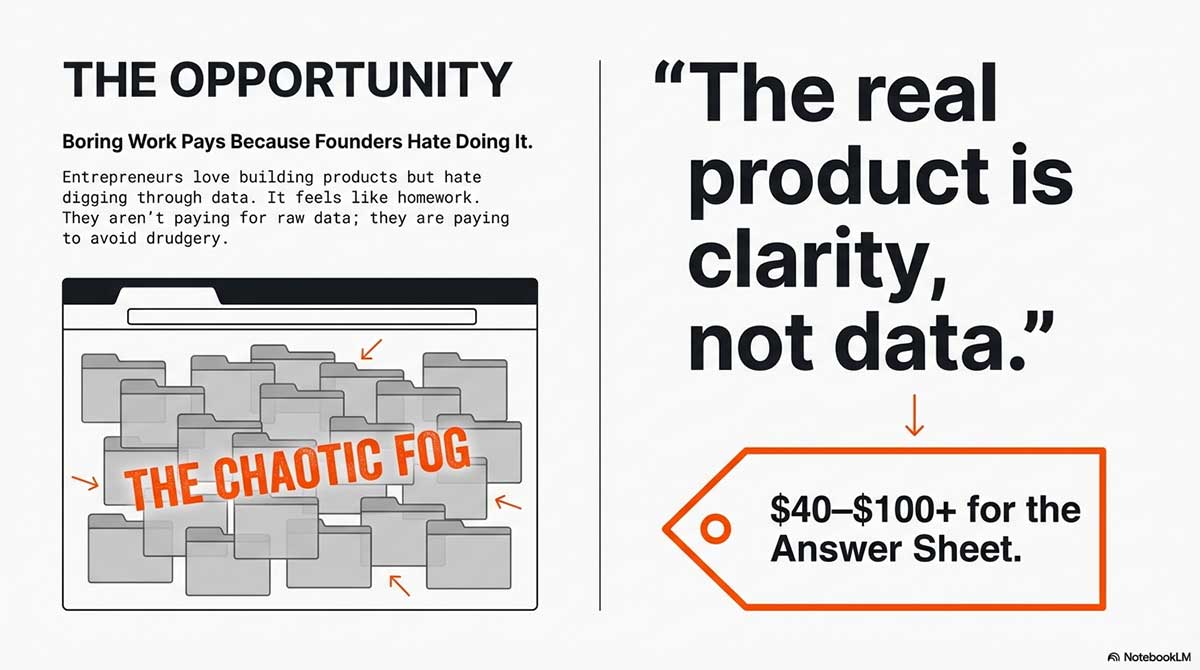
Because here’s the awkward truth about entrepreneurship: people will happily pay $40 to avoid the part of business that feels like homework. They want the “answer sheet.” They want the “what should I do?” They want someone else to stare into the chaotic fog of the internet and return with a short, confident summary and a plan.
And if you’ve ever opened 37 browser tabs while whispering “I’m almost done,” you already understand the pain you’re solving.
This article will show you how to get paid for that pain relief using AI, in a way that’s faster, cleaner, and more consistent than the typical Fiverr “market research gig” you see out there. You’ll learn a simple three-step workflow, and you’ll get a copy/paste deliverable template you can use for every client (or for your own ideas) without reinventing the wheel each time.
No MBA required. Just curiosity, a little common sense, and the willingness to turn AI output into something a human can actually use.
To watch a demonstration of how it works, you can watch the AIville workshop video here.
The “Boring Pays” Truth Nobody Wants to Admit
Why people pay for “homework” they could do themselves
Entrepreneurs love building. They hate digging.
Market research is digging. It’s not glamorous. It’s not a logo. It’s not a dopamine hit. It’s not even a good story at dinner parties.
“What did you do today?”
“I read 83 competitor reviews and categorized pain points.”
“…so you’re okay?”
So founders outsource it. Not because they’re lazy in a bad way, but because they’re busy in a real way. They want momentum, not more reading.
The real product is clarity, not data
Your deliverable is not “information.”
Your deliverable is:
A decision the client can make
A direction the client can act on
A recommendation that reduces uncertainty
Think of yourself as a translator between “the internet” and “a human trying to launch something.”
The $40 model: low ticket, high volume, upsells (without being sleazy)
Many Fiverr sellers start at a low price because it’s easier to get orders and reviews. That can work, but only if you have:
a clear scope (so you don’t do unlimited work for $40)
a consistent output format (so delivery is quick)
optional add-ons that buyers actually want
Upsells do not need to be gross. They can be “You want deeper competitor breakdown?” “You want customer personas?” “You want a go/no-go scorecard?” Those are legitimately valuable.
Who This Is For (And Who Should Skip It)
Perfect for
Freelancers who like frameworks and writing
Marketers, creators, operators, consultants
People who want a service they can deliver in 2–6 hours, not 2–6 days
Not ideal for
People who hate summarizing and formatting
People who want “push button, get rich”
People who dislike client messaging and simple boundaries
What you need to be “qualified”
You need to be able to do three things:
Ask good scoping questions
Use AI to generate draft research
Edit it into a decision-ready report
That’s it. Nobody is hiring you for your PhD. They are hiring you to save them time and prevent expensive mistakes.
The Offer in One Sentence
Here are three strong versions:
Option A (simple and strong)
“Decision-ready market research report in 48 hours.”
Option B (more specific)
“Market + competitor analysis with clear positioning recommendations.”
Option C (for idea validation)
“Go/no-go business idea validation with a 7-day test plan.”
What decision-ready means
It means you do not deliver a 12-page “maybe.”
You deliver:
- what the market is
- who pays and why
- who you compete with
- where the gap is
- what to test next
If your report doesn’t change what the buyer does next, it’s not a report. It’s a blog post with no comments.
The 3-Agent Workflow (The Only Process You Need)
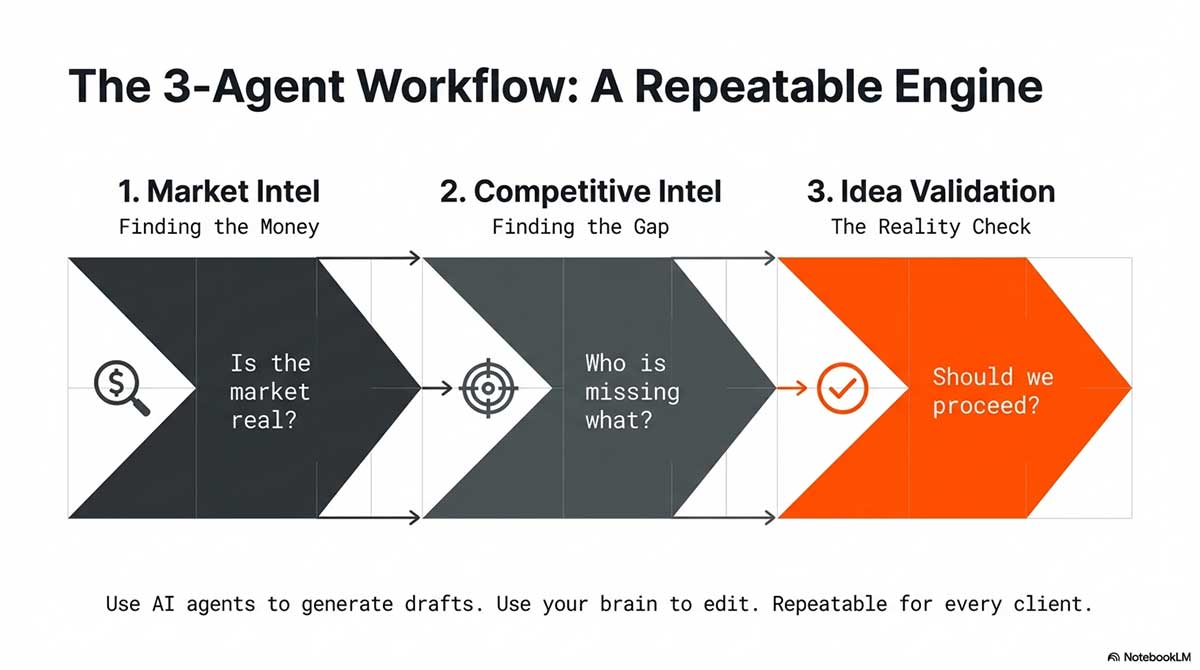
Here’s the workflow we’ll use every time:
Market Intel → Competitive Intel → Idea Validation
You can do this for your own projects, or as a service for clients. The magic is not the AI. The magic is doing these in order and packaging the result cleanly.
What the final deliverable looks like
Before you start, know what you’re building:
- 1-page Executive Summary
- Market Overview + Trends
- TAM/SAM/SOM with assumptions
- Customer Personas + buying triggers
- Competitor Matrix + review insights
- Positioning recommendation + offer angle
- Risks + mitigations
- Go/No-Go scorecard
- 7-day validation plan
That is what people pay for. The AI helps you fill it quickly.
Step 0: The One-Paragraph Brief (Garbage In, Garbage Out)
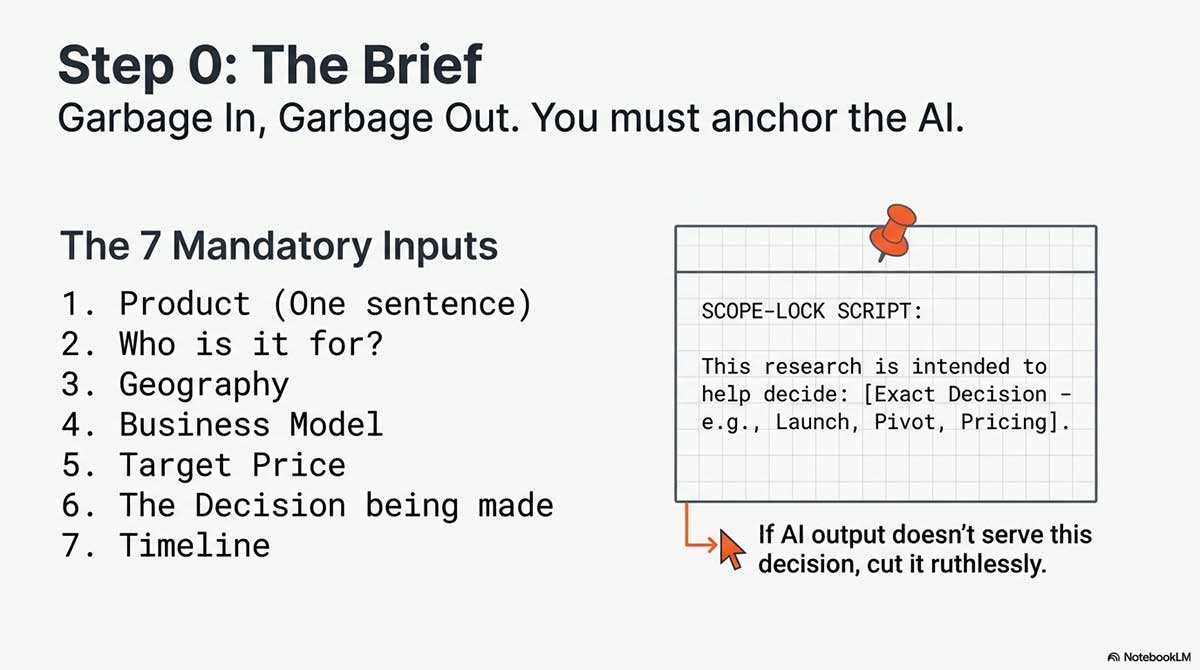
If you skip this, everything becomes mush.
The 7 inputs you must collect
Whether it’s your idea or a client’s, get these:
- What is the product or service? (one sentence)
- Who is it for? (specific segment)
- Geography (where are buyers?)
- Business model (subscription, one-time, retainer, etc.)
- Target price range
- The decision they’re trying to make (launch, pivot, pricing, niche choice)
- Timeline (this month or “someday”)
The scope-lock trick
Write this sentence at the top of every report:
“This research is intended to help decide: [exact decision].”
If the AI output doesn’t serve that decision, you cut it. Ruthlessly.
Client intake questions (copy/paste)
Send this to clients before you start:
- What are you trying to decide after reading this report?
- Who is the ideal buyer? (job, situation, industry, skill level)
- Where do they live or operate?
- What price do you want to charge?
- What’s your current idea in one sentence?
- Who do you think your competitors are? (optional)
- Do you want a recommendation, or just raw research?
Step 1: Market Intel (Find the Money and the Why)
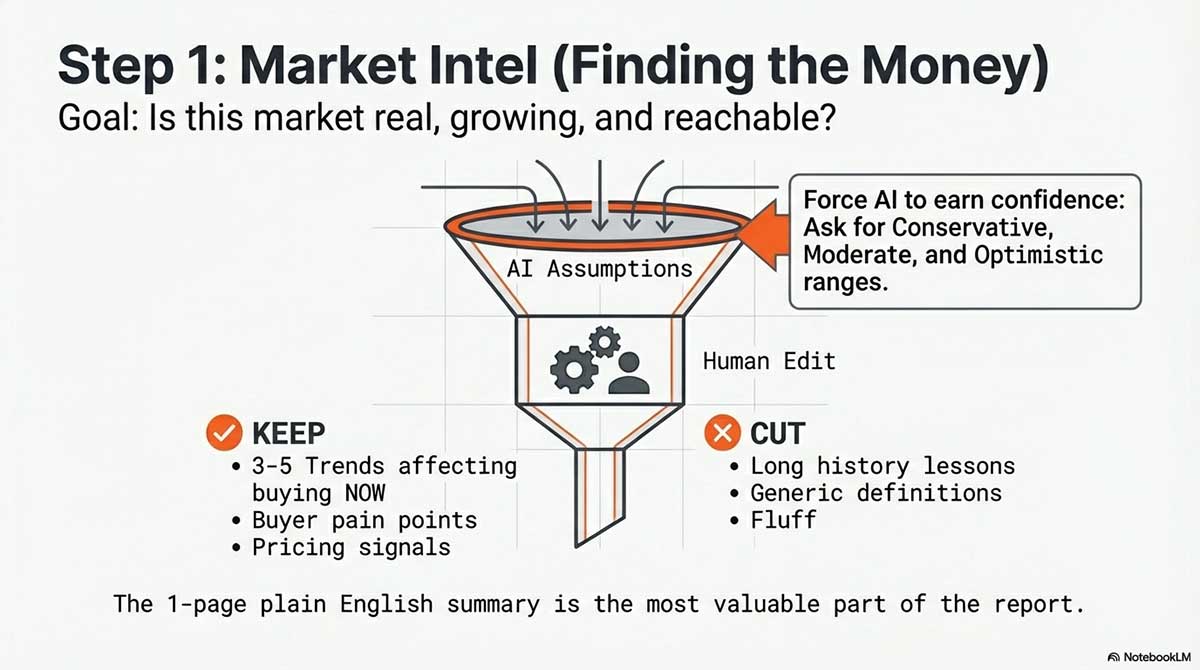
This step answers: Is this market real, growing, reachable, and worth entering?
What to ask for
Ask AI for:
- market definition and scope
- key trends and drivers
- barriers and risks
- buyer segments and needs
- TAM/SAM/SOM with logic and assumptions
- willingness to pay (signals, not fantasies)
Force assumptions and ranges
AI loves confident numbers. Your job is to make it earn its confidence.
Always add:
- “State assumptions clearly.”
- “Provide conservative, moderate, and optimistic ranges.”
- “List what would make these estimates wrong.”
What to keep vs what to cut
Keep:
- 3–5 trends that affect buying now
- buyer segments and pain points
- pricing signals
- risks that actually matter
Cut:
- long history lessons
- generic “AI is growing” filler
- 12-paragraph definitions nobody asked for
The 1-page executive summary method
After the AI draft, you write a one-page summary in plain English. Your client will read this first, and sometimes only this. Make it count.
Include:
- the market in one sentence
- who pays
- what they want
- why now
- key competitors
- your recommended angle
- next tests
Step 2: Competitive Intel (Find the Gap You Can Actually Win)
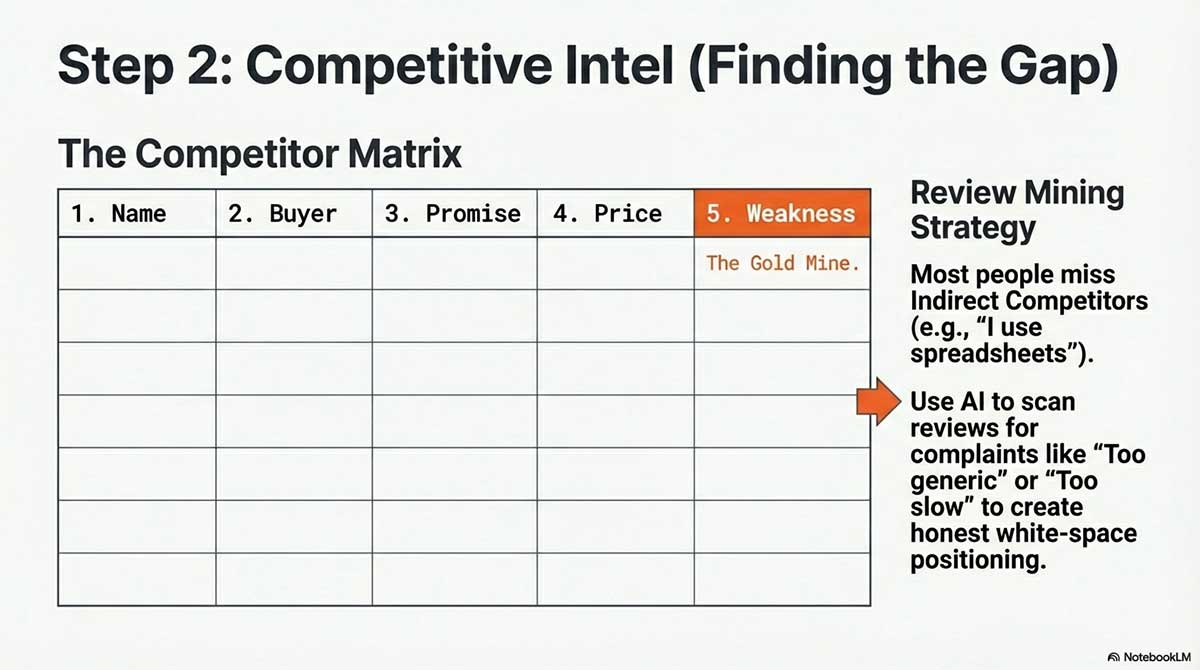
This step answers: Who wins today, and what are they missing?
Direct vs indirect competitors
Direct competitors: same solution, same buyer.
Indirect competitors: different solution, same problem.
Substitutes: “I do nothing” or “I use spreadsheets and suffer.”
Most people only list direct competitors and miss substitutes, which is often the real reason buyers don’t convert.
The competitor matrix buyers love
Create a simple matrix with 5 columns:
- Competitor name
- Target buyer
- Core promise
- Pricing range
- Weakness from reviews
That last column is the gold. It gives you positioning that isn’t made up.
Reviews mining: complaints, praise, switching triggers
Ask AI to summarize patterns from reviews:
- What do buyers praise repeatedly?
- What do buyers complain about repeatedly?
- Why do people switch?
- What do people wish existed?
This creates an easy, honest “we’re different because…” story.
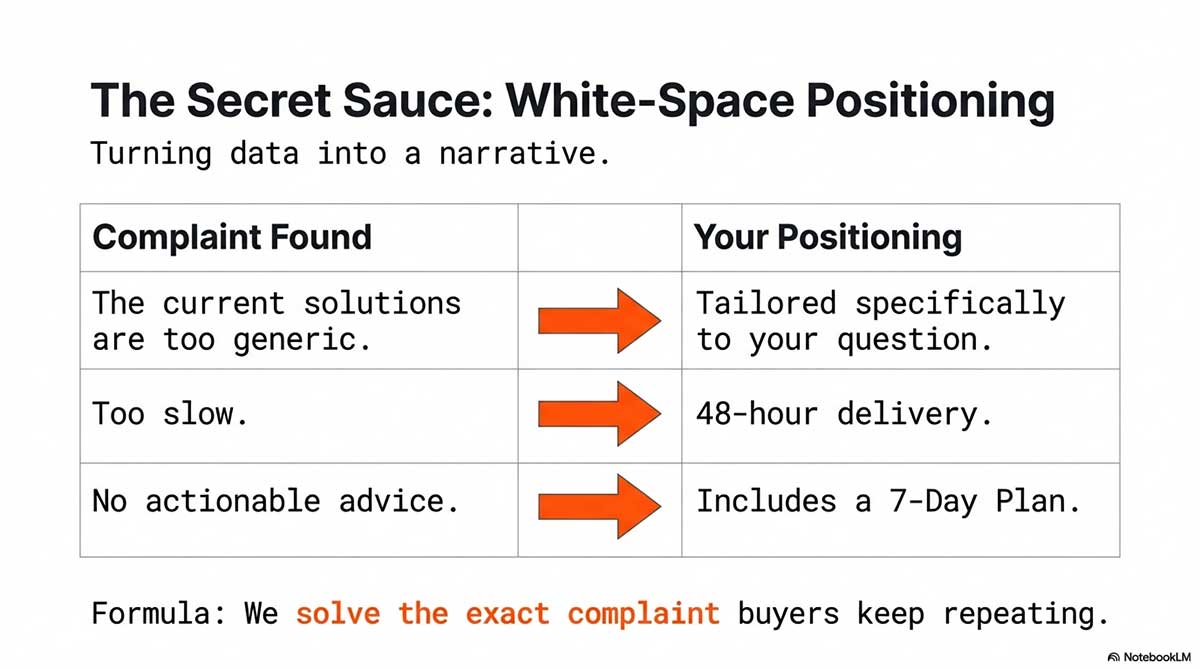
White-space positioning without sounding vague
Bad positioning: “We’re better and easier.”
Good positioning: “We solve the exact complaint buyers keep repeating.”
Example:
- “Too generic” → you offer “decision-ready, tailored to your question”
- “Too slow” → you offer “48-hour delivery with a 1-page summary”
- “No actionable recommendation” → you include “go/no-go + 7-day plan”
Step 3: Business Idea Validation (Go/No-Go Without the Drama)
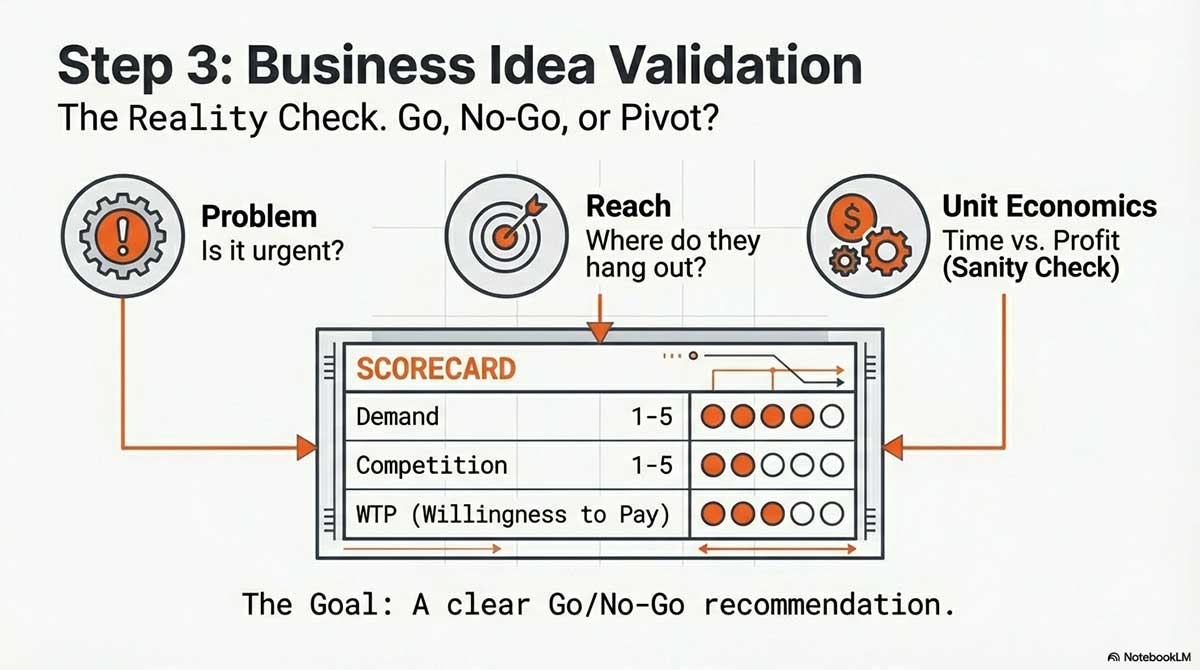
This step answers: Should we pursue this, pivot it, or kill it quickly?
Validate the problem
Ask:
- How urgent is it?
- How often does it occur?
- What do people do today instead?
- What do they pay for alternatives?
- What proof exists that they want something better?
Validate reach
The biggest silent failure in business is not demand, it’s distribution.
Ask:
- Where do these buyers spend time?
- Who already has their attention?
- What’s the cheapest way to reach them?
- What would a “first test” look like?
Unit economics basics
You do not need a finance degree. You need a sanity check.
For a service:
- How many hours does it take you?
- What’s your minimum profitable price?
- What’s the maximum you can deliver weekly without losing your mind?
Your future self will thank you for not selling a “premium package” that costs your soul.
Go/No-Go scorecard + next tests
Score the idea 1–5 on:
- demand
- competition intensity
- willingness to pay
- reachability
- delivery feasibility
Then list:
- 3 things that must be true
- 3 fastest tests to verify them
Turn Outputs Into a Sellable Deliverable (The Report Template)
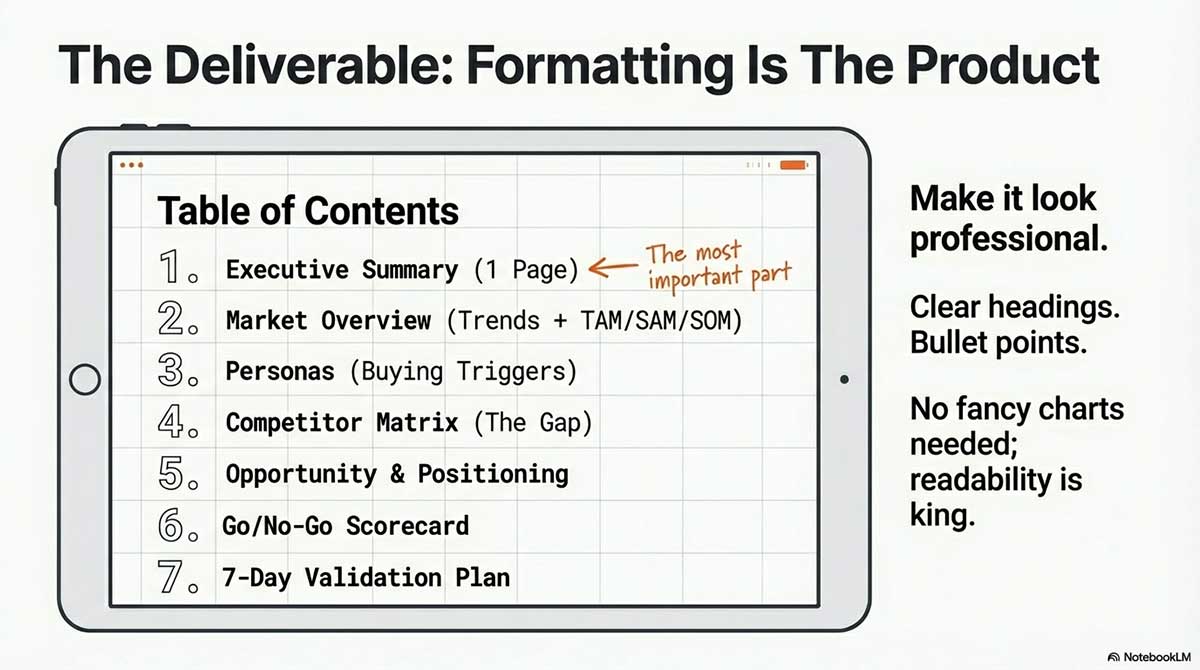
Here’s the secret: your service is not “asking AI questions.”
Your service is:
turning messy outputs into a clean report someone can act on.
Formatting is the product.
The Decision-Ready Report (table of contents)
- Executive Summary (1 page)
- Market Overview + Trends
- Market Size (TAM/SAM/SOM) + assumptions
- Customer Personas + buying triggers
- Competitor Snapshot + matrix
- Opportunity + positioning recommendation
- Risks + mitigations
- Go/No-Go scorecard
- 7-day validation plan
Make it look professional without fancy tools
Use:
- clear headings
- bullet points
- short paragraphs
- bold key conclusions
- one simple matrix table
You don’t need fancy charts. You need readability.
What visuals to include
If you include visuals, keep them simple:
- a matrix table
- a 3-bullet trend list
- a scorecard
No screenshots with readable proprietary text. Keep it clean.
Copy/Paste Deliverable Template (Use This Every Time)
Paste this into a Google Doc and reuse it forever:
Executive Summary (1 page)
- Decision this report supports:
- Market in one sentence:
- Best buyer segment to start with:
- The “why now” drivers:
- Top competitors and what they do well:
- Biggest gap to exploit:
- Recommended positioning:
- Next 3 tests:
Market Overview + Trends
- Market definition:
- 3–5 major trends:
- Growth drivers:
- Risks/barriers:
TAM/SAM/SOM + assumptions
- TAM estimate + logic:
- SAM estimate + logic:
- SOM estimate + logic:
- Assumptions:
- Range scenarios:
Customer Personas + buying triggers
Persona 1:
- Who they are:
- Pain points:
- Buying triggers:
- Objections:
- Willingness to pay signals:
Competitor Snapshot + matrix
Matrix:
- Competitor / Buyer / Promise / Price / Weakness from reviews
Opportunity + positioning recommendation
- Best entry wedge:
- Offer angle:
- Messaging bullets:
- Differentiators tied to real complaints:
Risks + mitigations
- Risk:
- Mitigation:
Go/No-Go Scorecard
Scores 1–5:
- Demand:
- Competition:
- Willingness to pay:
- Reachability:
- Delivery feasibility:
Overall: - Go / No-Go / Pivot
7-Day Validation Plan
Day 1–2:
Day 3–4:
Day 5–7:
Pricing and Packages (Fiverr-Friendly, Not Confusing)
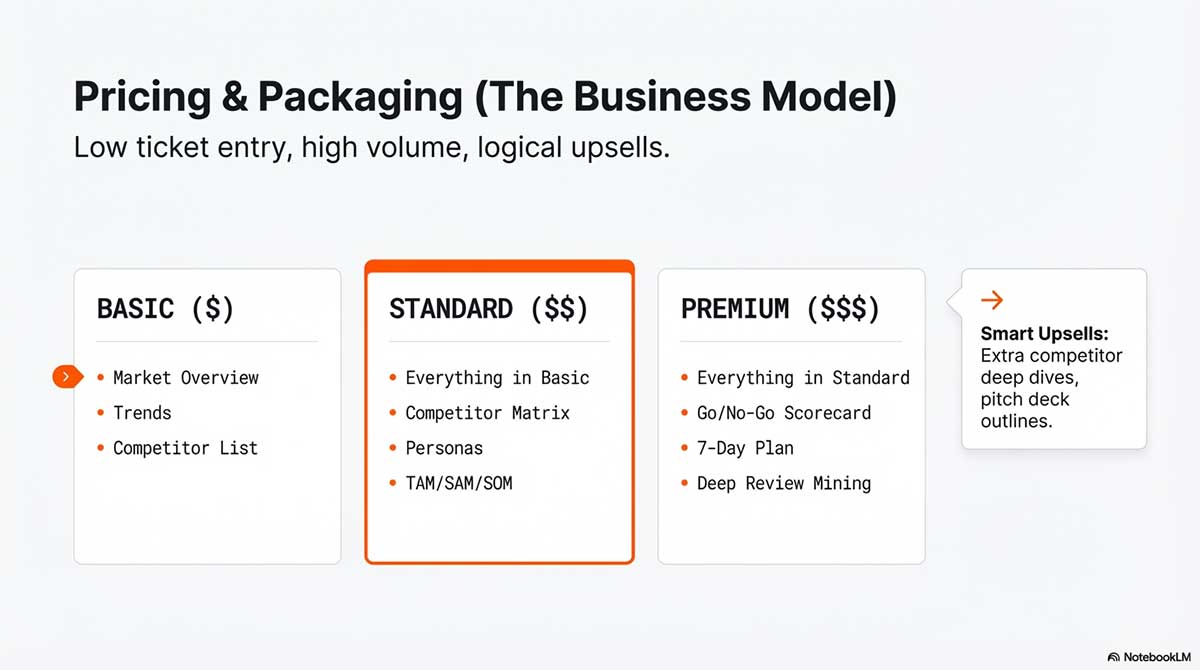
Basic / Standard / Premium
Basic: market overview + trends + competitor list + 1-page summary
Standard: includes TAM/SAM/SOM + competitor matrix + personas
Premium: includes validation scorecard + 7-day plan + deeper review mining
Easy upsells clients actually want
- extra competitor deep dive
- buyer persona pack (2–3 personas)
- pricing and packaging recommendations
- landing page copy based on research
- pitch deck outline
Turnaround and boundaries
Pick your rules:
- 48-hour delivery for standard
- one revision pass
- “scope changes require add-on”
This keeps you profitable and sane. Both are underrated business goals.
How to Get Clients Without Begging
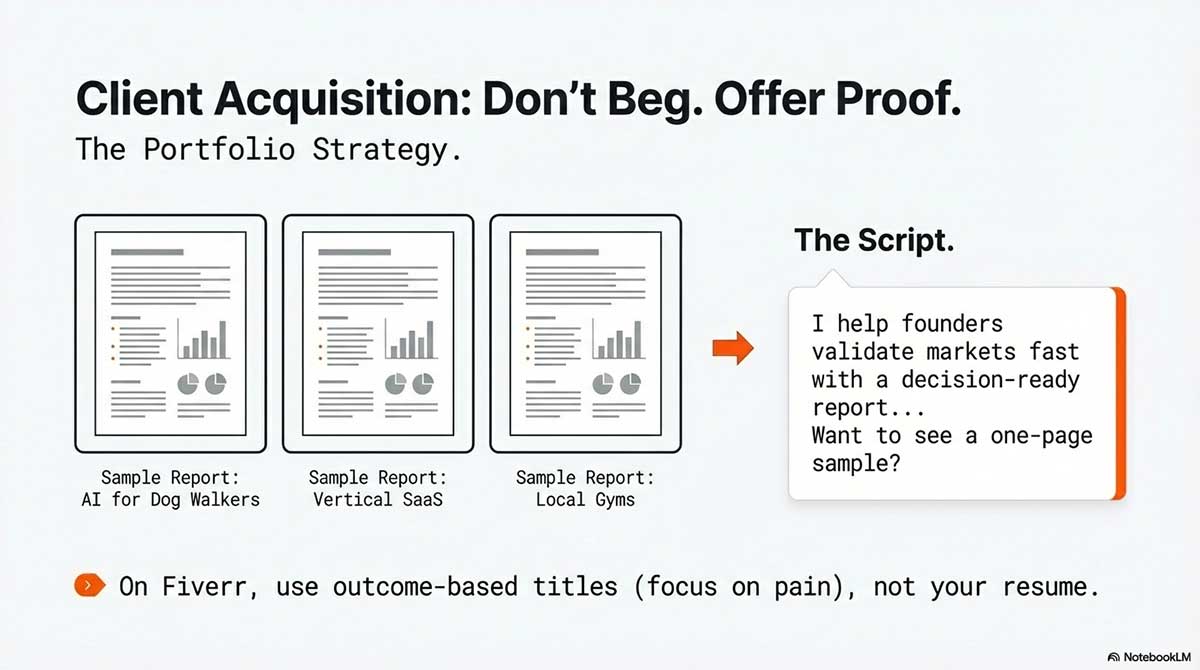
Fiverr setup basics
Use outcome-based titles
Show sample report pages as images (no sensitive text)
Make your description about buyer pain, not your resume
Include a “message me first” option
Portfolio samples that attract buyers
Create 2–3 public sample reports for trending niches. Post short snippets:
a competitor matrix screenshot
a 1-page executive summary screenshot
a go/no-go scorecard
These are proof. Proof sells.
Simple outreach scripts (LinkedIn/groups)
Message template:
“Hey [Name], I saw you’re working on [thing]. I help founders validate markets fast with a short decision-ready report. Want me to send a one-page sample?”
Short, polite, non-weird.
Quality Control and Ethics (So You Don’t Sell Fluff)
Verify key claims
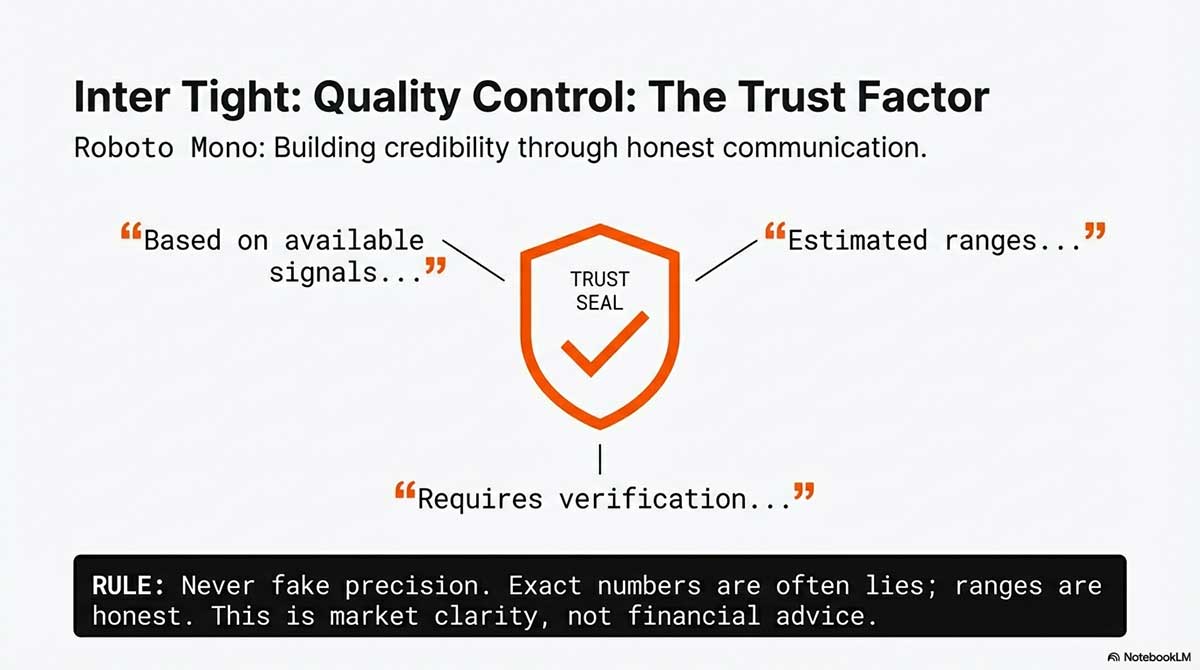
Do not promise perfect numbers. Provide ranges and assumptions. If a number is critical, label it “estimate” and explain the logic.
Present AI findings honestly
Use language like:
- “Based on available signals…”
- “A reasonable estimate suggests…”
- “This should be verified with…”
- “Key assumptions are…”
Clients will trust you more, not less.
Not financial advice
You are helping with market clarity, not guaranteeing results. Keep it practical, not hypey.
Common Mistakes (And How to Avoid Them)
Research before clarifying the decision
Always start with: “What decision are we making?”
Over-delivering pages instead of recommendations
Long is not helpful. Clear is helpful.
Markets too broad or too weird
Avoid:
“AI for everyone”
“All fitness”
“Everything in crypto”
Pick a tight entry wedge.
Forgetting the buyer’s real question
The buyer asks: “Should I do this?”
Answer that clearly.
Your First 48 Hours Plan (So You Actually Start)
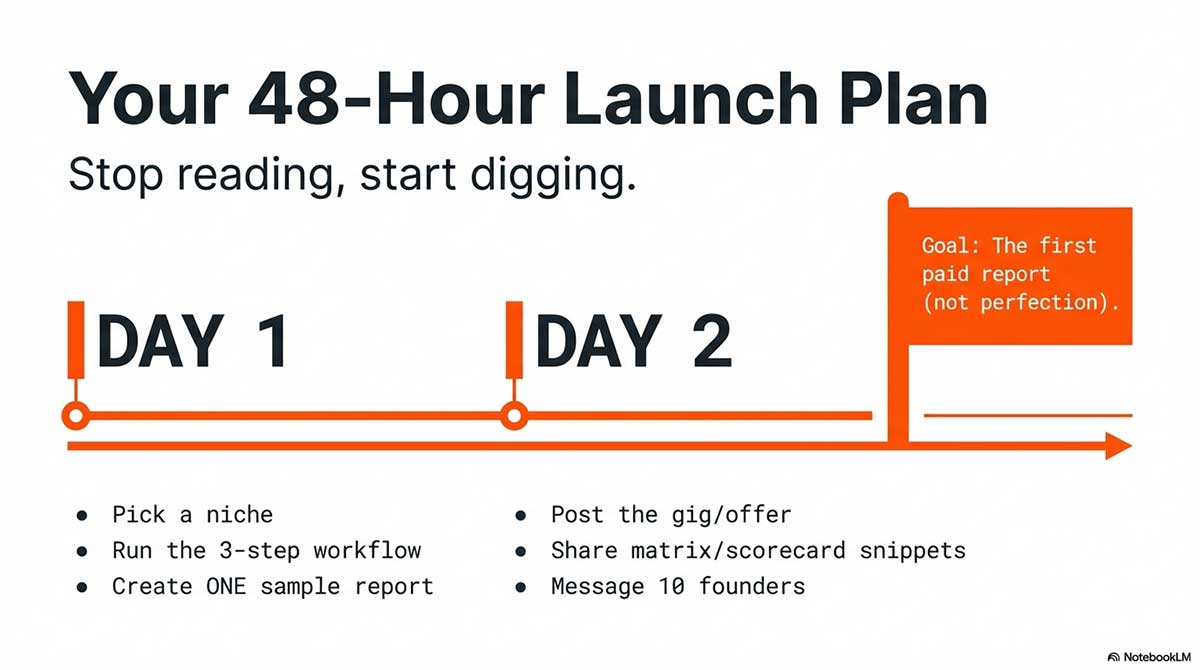
Day 1
Pick one niche
Run the 3-step workflow
Create one sample report
Day 2
Post your gig or offer page
Share 3 proof snippets online
Message 10 founders with your one-page sample
Your first goal is not perfection. Your first goal is your first paid report.
FAQs
Do I need paid tools?
No. You can start with free AI tools, but better tools and templates reduce time and improve output.
How long should a report be?
Usually 5–12 pages. The executive summary matters more than the page count.
What niches work best?
Niches where bad decisions cost money and buyers are active online: B2B services, software, education, wellness, local services, creator products.
What if clients want exact numbers?
Give ranges, assumptions, and what to verify. Exactness is often fake precision.
Final Thoughts: You Don’t Need to Be a Researcher
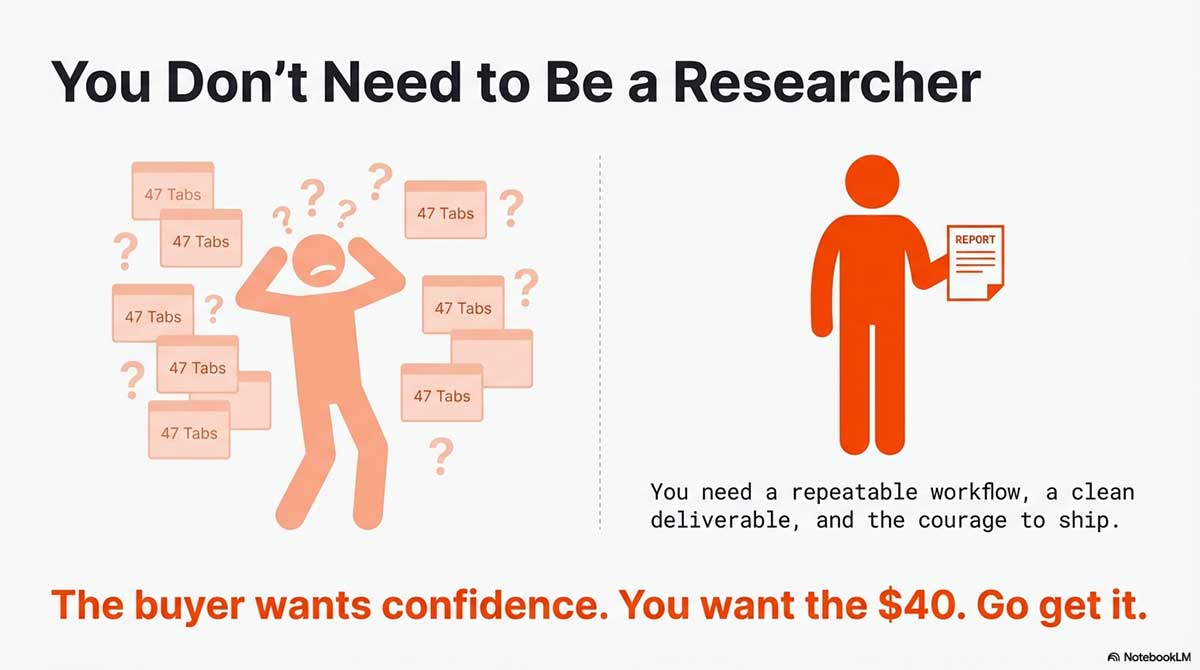
You need:
- a repeatable workflow
- a clean deliverable
- and the courage to ship the report instead of collecting one more “just in case” detail
Because your buyer doesn’t want a novel. They want confidence.
And you don’t want 47 tabs. You want 47 dollars. Minimum.
To watch a demonstration of how it works, you can watch the AIville workshop video here.
Leave a Reply