
Before you build, validate.
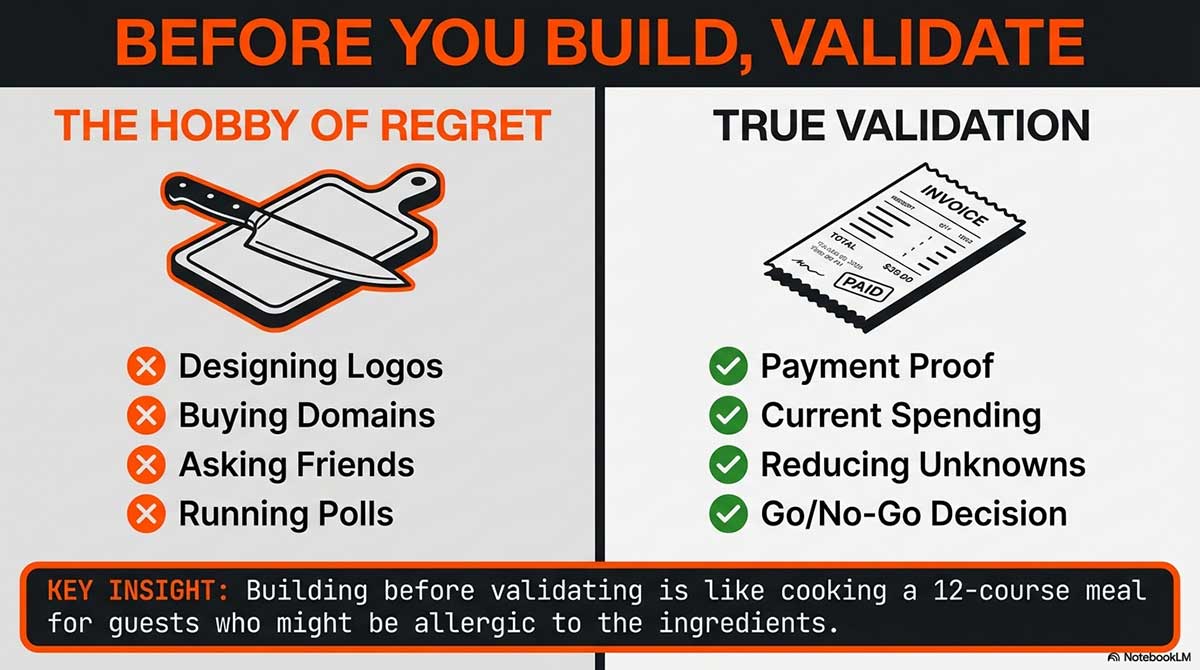
Because building first and validating later is like cooking a 12-course meal before asking your guests if they’re allergic to everything. You might still get applause, but it’ll be from paramedics.
This guide shows a time-boxed, step-by-step validation sprint you can run in 60 minutes using AIville as your “research cockpit.” You’ll follow a safe, broad example idea, fill out a scorecard, and finish with next actions you can execute this week.
If you want the home base for all my AIville notes and reviews, start here
And if you want to watch the workshop training that this workflow supports, here’s the workshop page.
Before You Build, Validate (Or Enjoy Your New Hobby: Regret)
Most business ideas don’t fail because the founder is “bad.” They fail because:
- The pain wasn’t real enough
- The buyer couldn’t be reached affordably
- The market was crowded in a way that required a big brand budget
- The offer was vague
- Or the idea was fine but the positioning was not
Validation is just a fast way to reduce “unknowns” before you spend money, time, and emotional energy.
What “validation” means (and what it doesn’t)
Validation is not:
- Asking your friends if they like it (friends are kind, not accurate)
- Posting a poll (polls measure opinions, not purchases)
- Reading a few Reddit threads and declaring victory
Validation is:
- Identifying who pays and why
- Mapping what they buy today instead
- Finding proof they spend money on solutions
- Checking if you can reach them without burning your budget
- Running a small test that gives real signals
The 60-minute promise
In 60 minutes you can’t “prove” a business will succeed.
But you can absolutely decide:
- Go
- No-Go
- Go with constraints (pivot the niche, price, or offer)
That alone can save you weeks.
The Setup: What You Need Before the Timer Starts
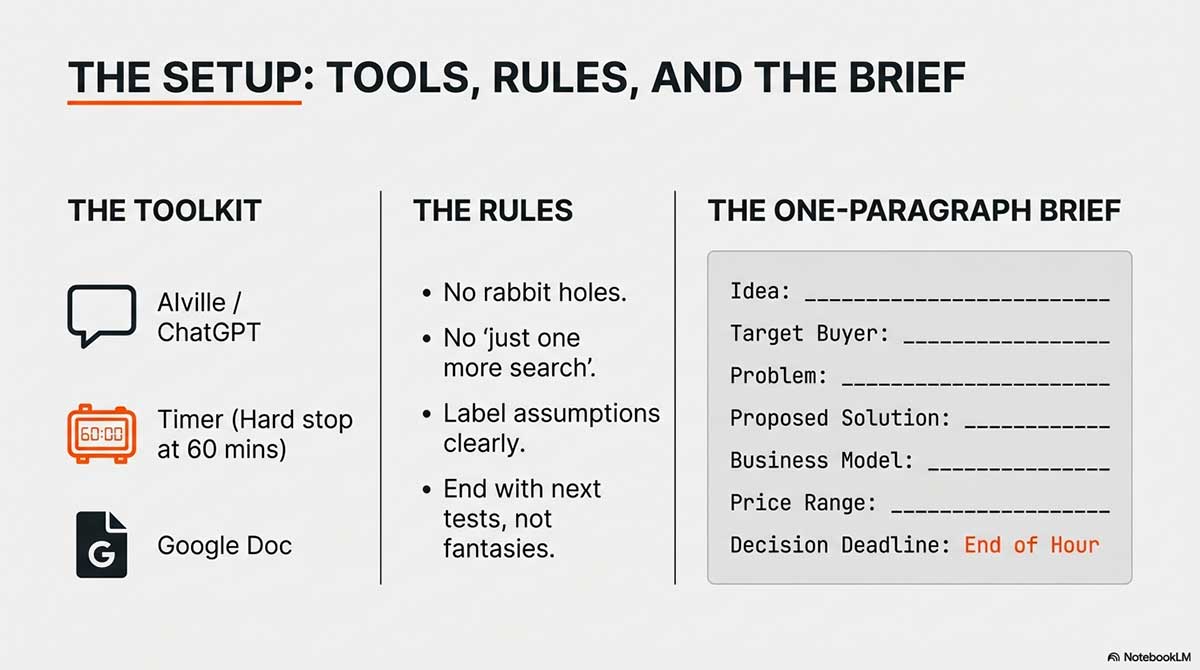
Tools and tabs (keep it simple)
You need:
- AIville (or ChatGPT plus your own templates)
- a note doc (Google Doc is fine)
- a timer
- one page to write the idea brief
The one-paragraph idea brief (copy/paste)
Fill this in before you start:
Idea:
Target buyer:
Problem:
Proposed solution:
Business model (how you get paid):
Price range:
Geography:
Decision I want to make by the end of this hour:
Rules of the hour
- No rabbit holes
- No “just one more search”
- If something is uncertain, label it as an assumption
- End with next tests, not fantasies
The Case Study Idea We’ll Validate (Safe, Broad Niche)
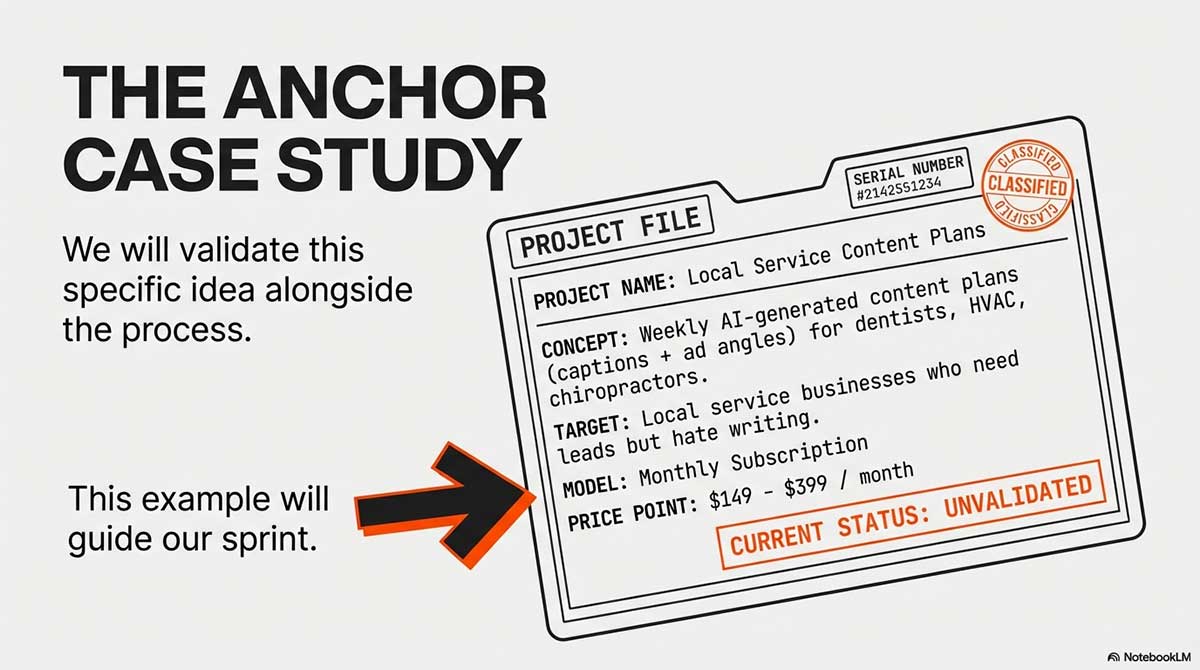
We’ll validate a simple idea that is safe, broad, and easy to understand:
The idea in one sentence
“A weekly AI-generated content plan for local service businesses (dentists, chiropractors, HVAC, plumbers), delivered as ready-to-post social captions + ad angles.”
Who it’s for
Local service businesses that want leads but don’t want to become full-time content creators.
Business model and target price
- Monthly subscription: $149–$399
- Optional upgrade: ads + landing page copy
This is broad enough to be realistic but specific enough to evaluate.
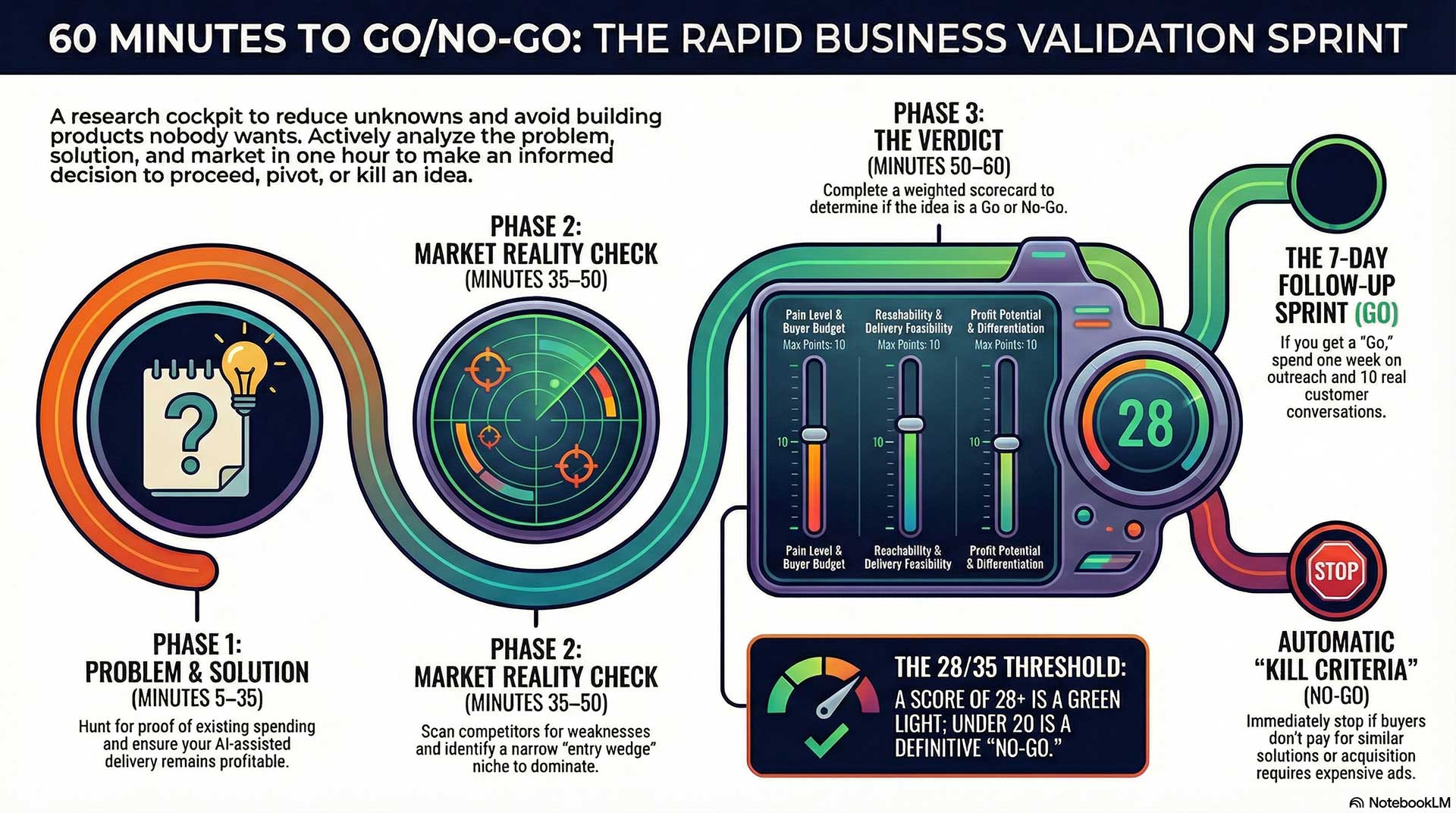
The 60-Minute Validation Map (Minute-by-Minute)
Minutes 0–5: Define the decision
What decision will you make today?
Minutes 5–20: Problem validation
Is it real? Is it urgent? Do people pay for help?
Minutes 20–35: Solution validation
Does your approach beat alternatives? Can you deliver it fast?
Minutes 35–50: Market + competition reality check
What are competitors charging? What are they missing?
Minutes 50–60: Scorecard + next actions
Go/no-go and the 7-day sprint.
Step 1: Define the Decision (5 Minutes)
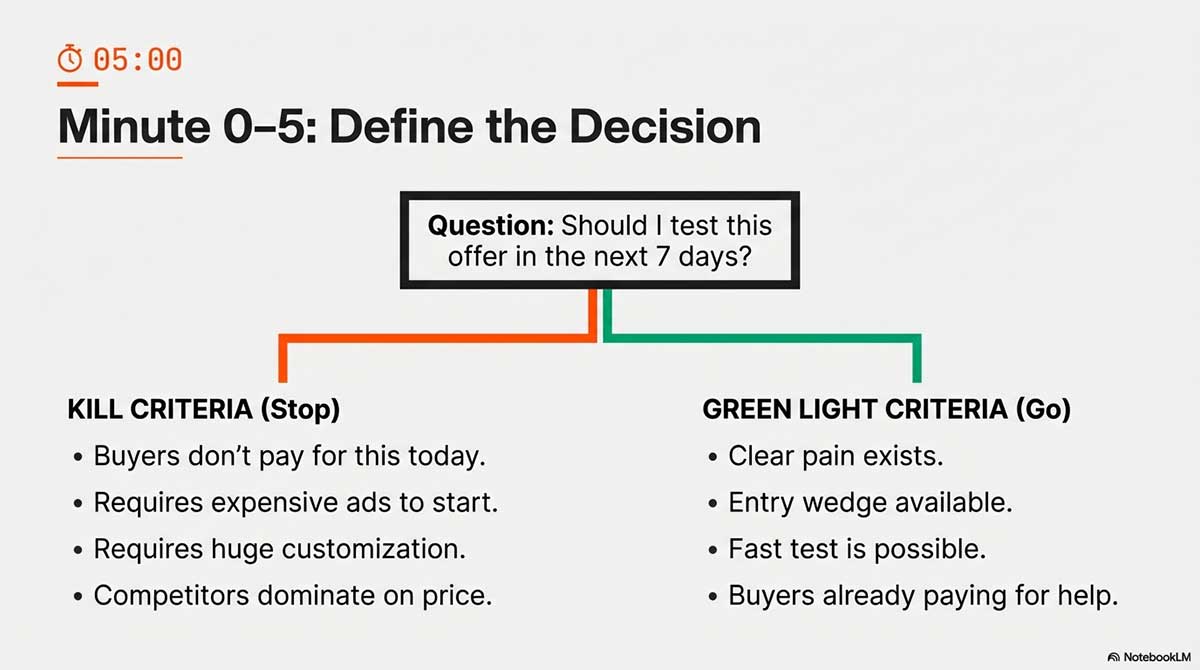
The exact question you’re answering today
“Should I test this offer for local service businesses in the next 7 days?”
Kill criteria (automatic No-Go)
If any of these are true, it’s a No-Go or pivot:
- Buyers don’t pay for anything similar today
- Acquisition would require expensive ads to start
- Delivery requires huge customization per client
- Competitors already dominate with cheap pricing + strong brand
Green light criteria
- Buyers already pay for marketing help
- A clear pain exists (leads, consistency, time)
- A simple entry wedge is available (one niche first)
- You can run a quick test within a week
Step 2: Problem Validation (15 Minutes)
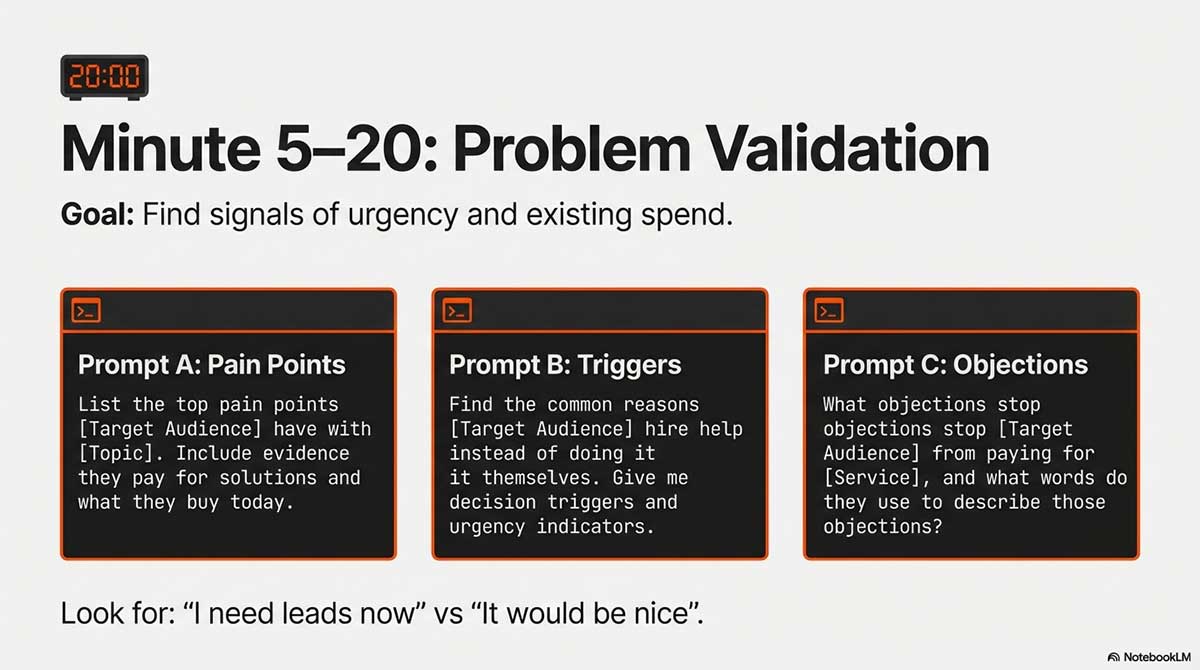
You’re hunting for signals, not vibes.
What to look for
- Existing spend: agencies, tools, freelancers
- Urgency: “we need leads now”
- Frequency: weekly marketing problem
- Frustration: “posting is hard,” “I don’t know what to say,” “ads don’t work”
Fast proof of willingness to pay
Look for:
- Agencies serving this niche
- Freelancers offering content plans
- Tools built for local business marketing
- Pricing pages, packages, “done-for-you” offers
Copy/paste prompts for problem validation
Use prompts like:
Prompt A
“List the top pain points local service businesses have with marketing and content. Include evidence they pay for solutions and what they buy today.”
Prompt B
“Find the common reasons local businesses hire marketing help instead of doing it themselves. Give me decision triggers and urgency indicators.”
Prompt C
“What objections stop local businesses from paying for content services, and what words do they use to describe those objections?”
Step 3: Solution Validation (15 Minutes)
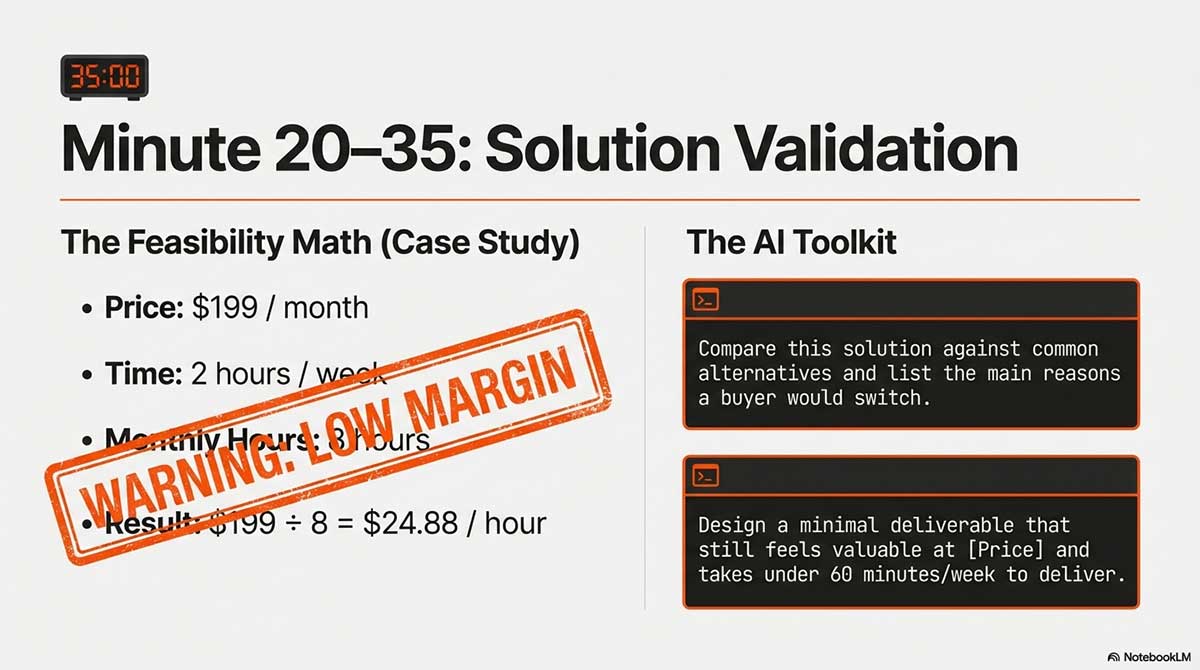
What makes your solution meaningfully different
The goal is not “better.” The goal is easier to choose.
Possible angles:
- “weekly plan in 24 hours”
- “post-ready captions + ad angles”
- “one niche specialization (dentists only)”
- “includes seasonal promos and local hooks”
Feasibility check
Ask:
- Can I deliver this in 60–90 minutes per client per week?
- Can AI handle 80% and I handle 20% polishing?
- Can I keep quality consistent?
Profit check
Example:
- Charge $199/month
- If delivery takes 2 hours/week = 8 hours/month
- That’s $24.88/hr before taxes, tools, and revisions
Not great.
Fix it:
- Tighten the deliverable
- Reduce customization
- Raise price
- Create tiered packages
Copy/paste prompts for solution validation
Prompt A
“Compare this solution against common alternatives and list the main reasons a buyer would switch.”
Prompt B
“Design a minimal deliverable that still feels valuable at $199/month and takes under 60 minutes/week to deliver.”
Prompt C
“Suggest a positioning hook that feels specific and credible for local service businesses.”
Step 4: Market + Competition Reality Check (15 Minutes)
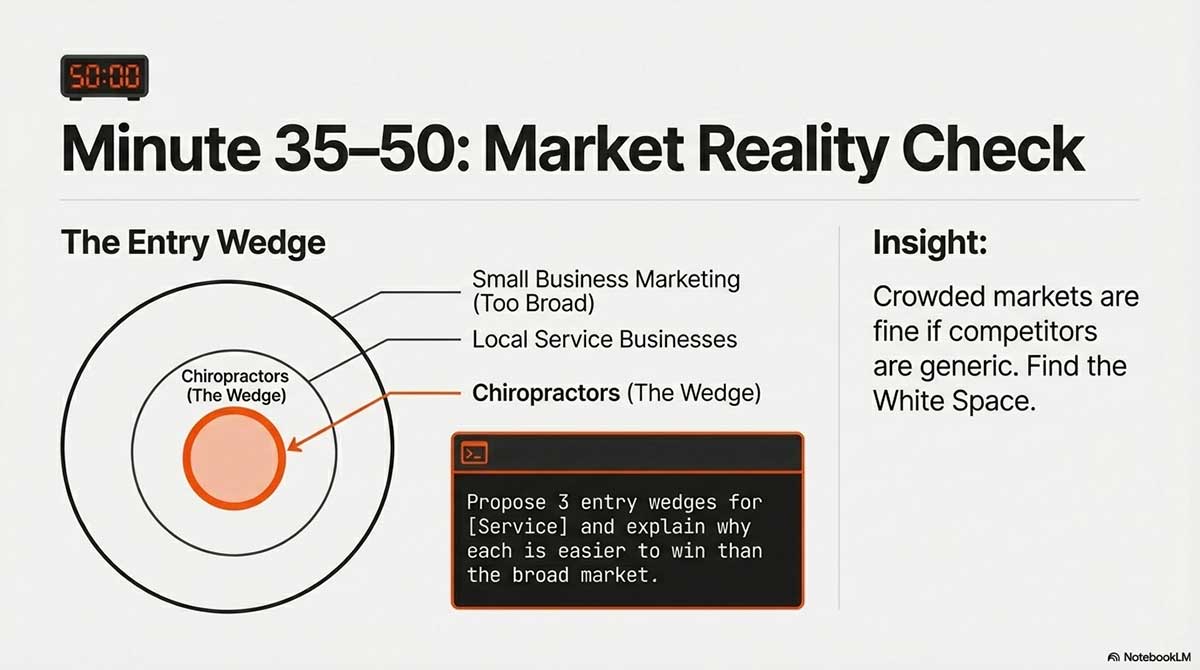
“Too crowded” vs “validated demand”
Crowded can be good if:
- Competitors are generic
- Reviews show dissatisfaction
- You can specialize
- You can wedge in with a tight offer
Competitor scan
Identify:
- Agency packages
- Freelancer offers
- Templates
- Local marketing SaaS
White space (entry wedge)
Instead of “local businesses,” pick:
- Dentists
- Chiropractors
- Med spas
- HVAC
One niche first makes messaging sharper.
Copy/paste prompts
Prompt A
“List the main competitor categories and typical pricing for local business content/marketing services.”
Prompt B
“Summarize competitor weaknesses based on customer complaints and gaps.”
Prompt C
“Propose 3 entry wedges and explain why each is easier to win.”
Step 5: Customer + Reach Validation (10 Minutes)
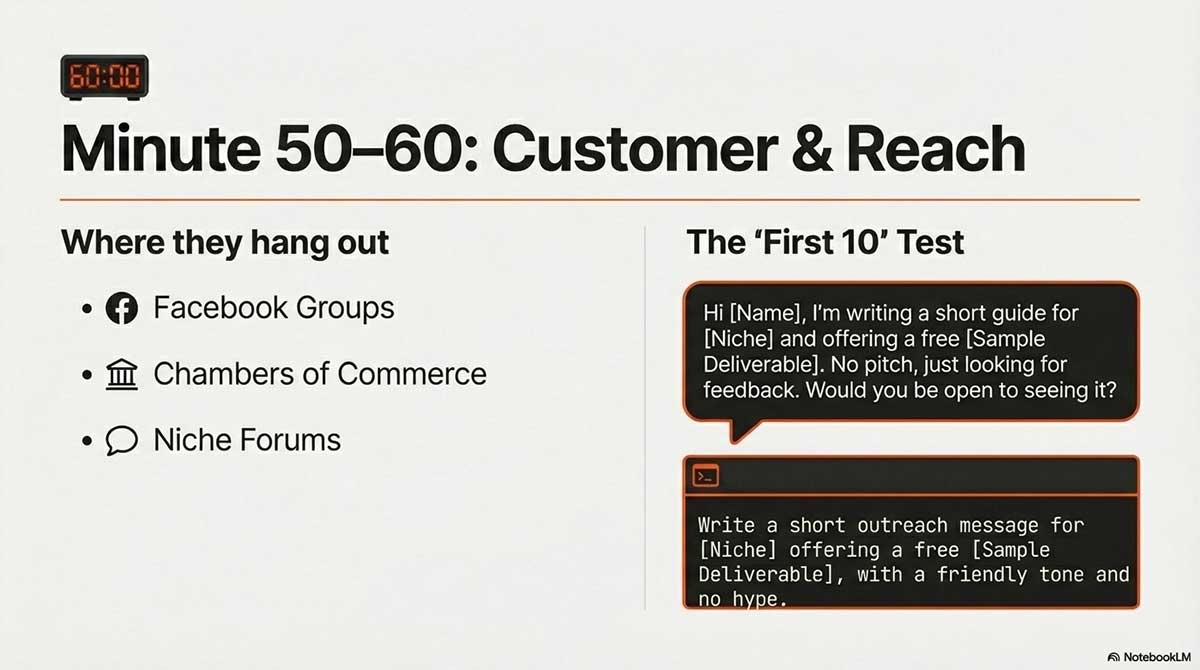
Where buyers actually are
- Local business Facebook groups
- Chambers of commerce
- Niche forums
- Local marketing communities
First 10 conversations plan
Your best test is human:
- Message 10 businesses
- Offer a free “one-page content plan sample”
- Ask what they currently do and pay for
- Ask what would make them switch
Messaging prompt
“Write a short outreach message for [niche] offering a free one-page content plan sample, with a friendly tone and no hype.”
The Go/No-Go Scorecard (Copy/Paste)
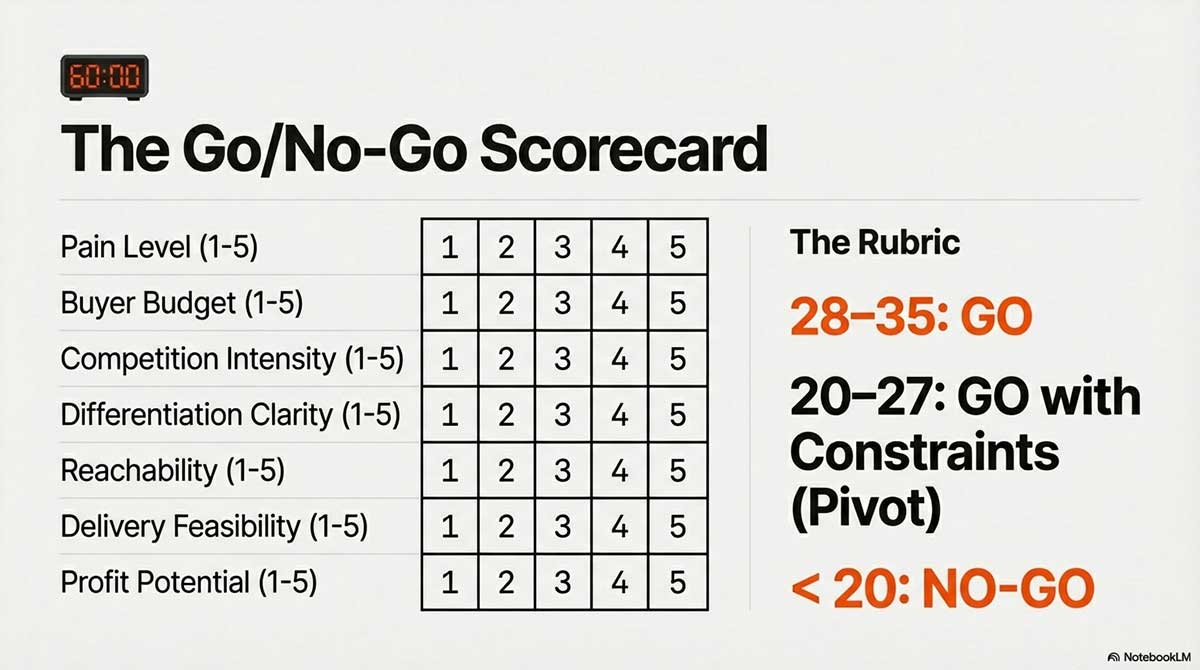
Score 1–5:
- Pain level:
- Buyer has budget:
- Competition intensity:
- Differentiation clarity:
- Reachability (cheap + direct):
- Delivery feasibility:
- Profit potential:
Total score (out of 35):
- 28–35 = Go
- 20–27 = Go with constraints/pivot
- under 20 = No-Go for now
Case Study Results (Example)
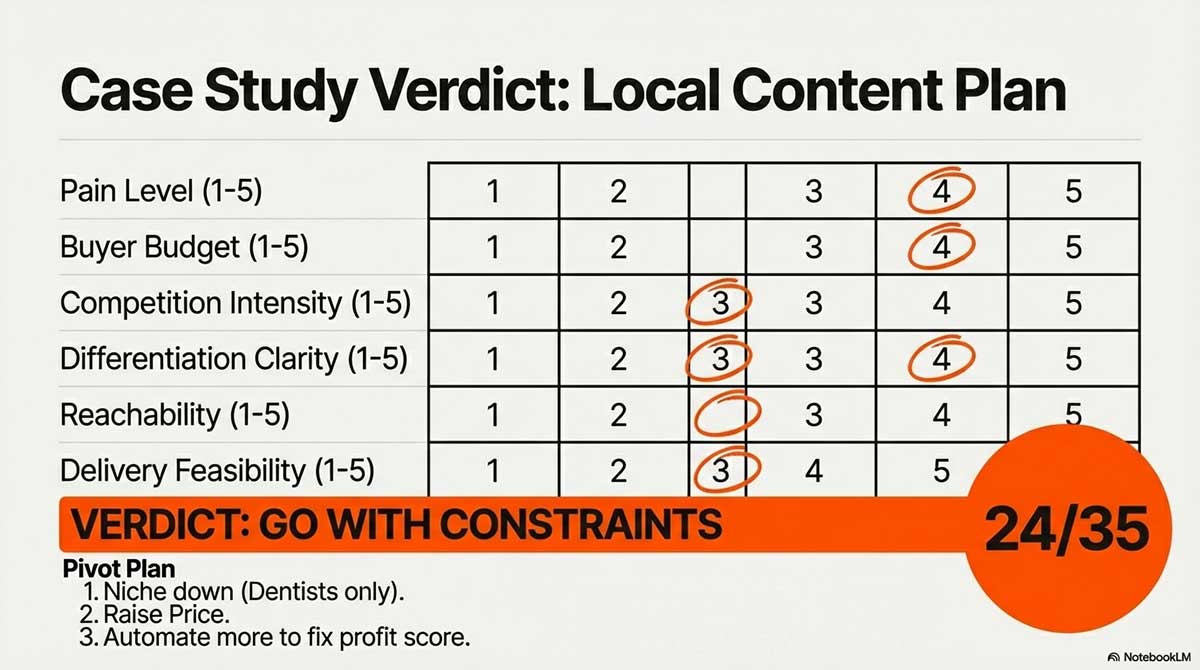
For the local business content plan idea:
- Pain level: 4
- Budget: 4
- Competition: 3
- Differentiation: 3
- Reachability: 4
- Delivery feasibility: 3
- Profit: 3
Total: 24/35 = Go with constraints
What we’d adjust
- Start with one niche (dentists or HVAC)
- Raise price or tighten deliverables
- Add upsells for landing page + ads
Next Actions: The 7-Day Validation Sprint
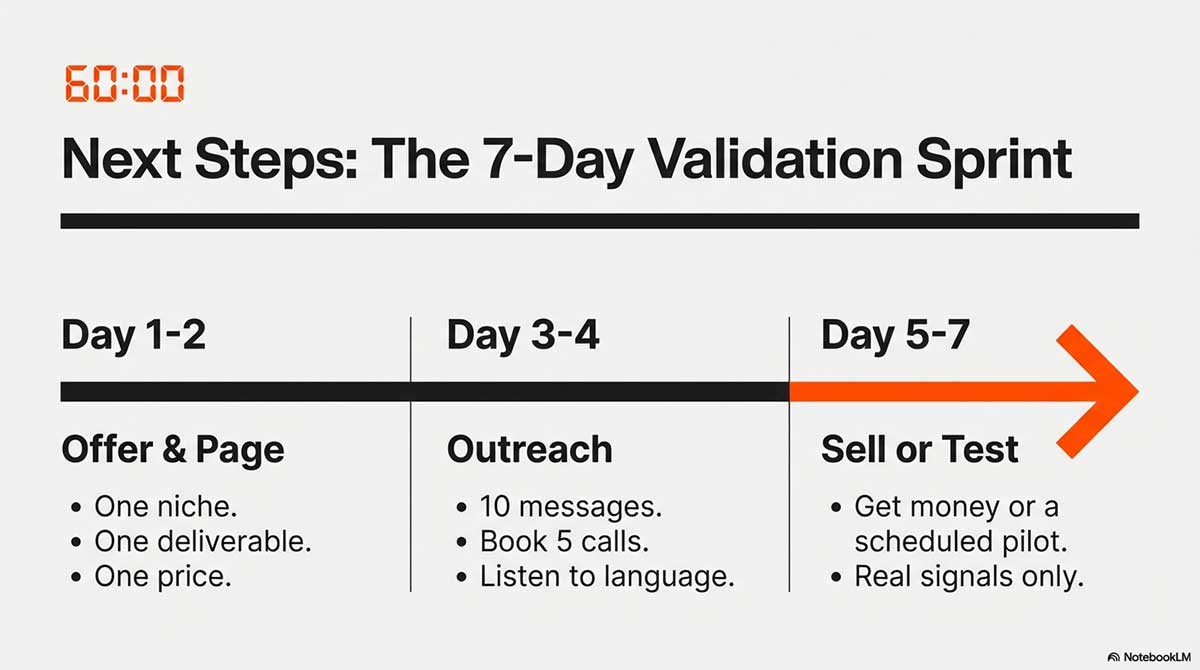
Day 1–2: Offer + page
- One niche only
- One clear deliverable
- One clear promise
- One clean price
Day 3–4: Outreach + 10 conversations
- 10 messages
- 5 calls
- Take notes on exact phrases
Day 5–7: Sell or test
- Offer pre-sale discount for first 3 clients
- Deliver a pilot week
- See if they renew
Common Ways People Cheat (And Still Call It Validation)
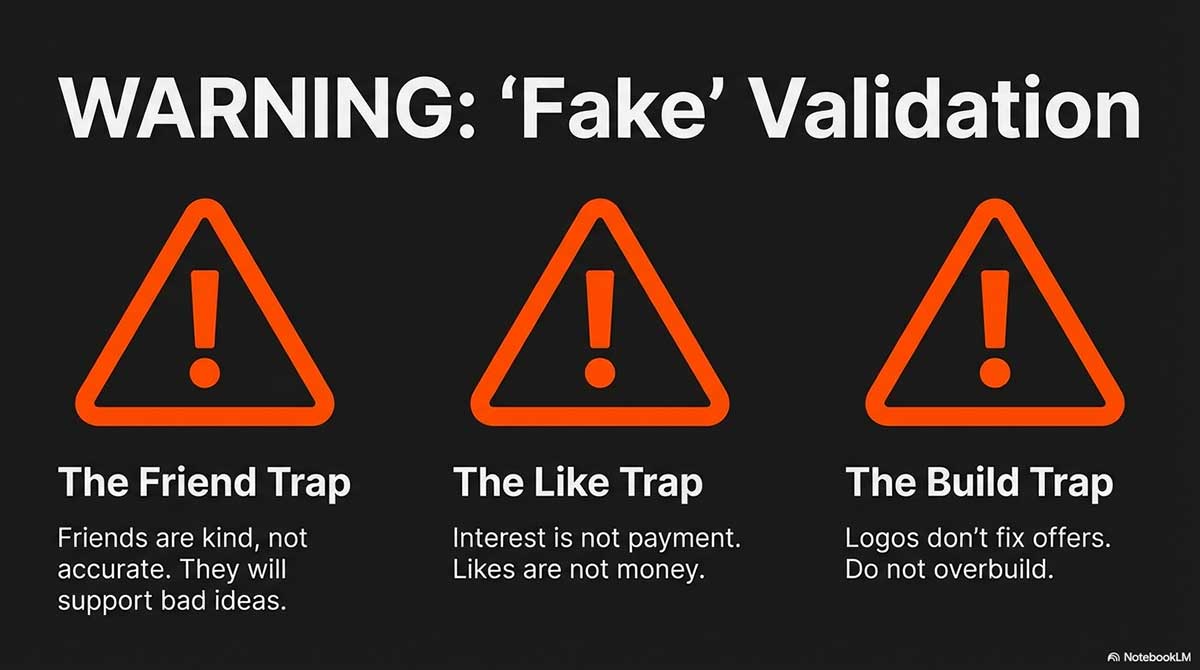
Asking friends
Your friends will support you even if your idea is “gluten-free ice cubes.”
Confusing interest with payment
Likes are not money. Money is money.
Overbuilding before proof
Your logo will not fix your offer.
Your offer will fix your logo.
Final Thoughts: Validation Is a Gift to Your Future Self
Before you build, validate. You’re not killing your dream. You’re protecting it from wasted effort.
If you want more workflows like this, you can always start at the main hub.
And if you want to watch the training workshop that pairs with this process, use the workshop page
Leave a Reply