
Autopilot Daily Cash Machine Explained
“Daily predictable profits” is one of those phrases that makes your brain do two things at once.
It leans forward and whispers, “Finally.”
It squints and asks, “Define predictable.”
That tension is exactly where smart people should live before they put money into anything that claims to be automated, AI-powered, and reliably profitable.
This article is not here to dunk on the idea or hype it up. It is here to translate the promise into plain English, clarify what “autopilot” usually means in real life, and help you decide whether this kind of system fits your personality, schedule, and risk tolerance.
Because if you are going to use an “autopilot” investing system, you want it to automate the right things, not automate your regret.
If you want a low-drama way to build skills around AI workflows, prompts, and repeatable routines before you touch anything high-risk, AIville is a solid place to practice the “process” side first. It is like learning to drive in an empty parking lot before you enter highway traffic at night in the rain.
What This System Claims to Do (In Plain English)
At a high level, Autopilot Daily Cash Machine and similar trainings usually promise some version of this:
- Use AI-driven tools or signals to identify trade opportunities
- Apply a repeatable method to enter and exit trades
- Do it in a simple daily routine
- Aim for consistent results over time
That is the clean version.
The marketing version is usually more like: “AI does the hard part so you can profit daily.”
The honest version is: “AI can help find patterns faster, but the system still depends on rules, execution, risk control, and market conditions.”
And the honest version is the one you want to build your expectations on.
“Daily Predictable Profits” vs What “Predictable” Can Realistically Mean
In investing, “predictable” almost never means “guaranteed.”
It usually means something closer to:
- Predictable process (you know what you will do each day)
- Measurable performance (you can track results and improve)
- Statistically repeatable edge (if the strategy has an edge, it tends to show over many trades)
So the best mental swap is this:
Replace “predictable profits” with “repeatable decisions.”
Because if a system gets you to repeat good decisions, profits become possible. Not guaranteed. Possible.
If a system gets you to repeat bad decisions quickly, losses become possible. Also not guaranteed. But possible with enthusiasm.
The Core Idea: AI-Driven Signals Plus Consistent Execution
Most AI investing systems live in one of these categories:
- AI helps you discover opportunities (scanning, pattern detection, alerts)
- AI helps you confirm opportunities (filters, scoring systems)
- AI helps you execute (bots, auto-orders, conditional rules)
- AI helps you review (summaries, journaling, performance analytics)
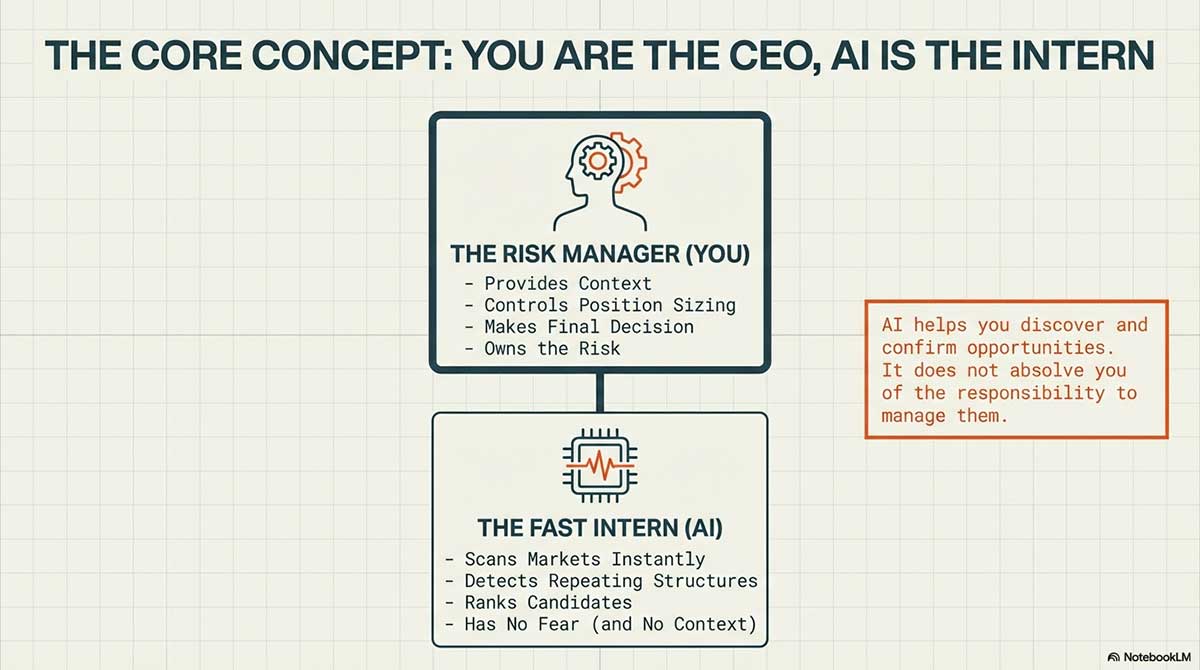
The key point is simple: AI is usually a tool inside the process, not the entire process.
Even if your entries are automated, you still need:
- Position sizing rules
- Exposure limits
- Exit logic (profit and loss)
- A routine for “when things get weird”
Crypto is very good at getting weird.
If you want to get practical fast, one of the best skills you can build is not “finding trades.” It is building a routine that forces you to act like a calm adult, even when the chart looks like it drank six energy drinks. If you like learning that kind of routine through templates and checklists, AIville has a lot of workflow-style training that makes this feel less like guesswork.
Why the Pitch Is Attractive (And Why That Matters)
It is attractive because it solves three pain points at once:
- You do not want to stare at charts all day
- You do not want to feel late to every opportunity
- You want results that feel consistent enough to trust
The problem is, when we want those things badly, we are more likely to:
- Ignore risk
- Underestimate volatility
- Oversize positions
- Confuse a good week with a good system
So the pitch being attractive is not a flaw. It is a psychological fact.
It just means you should set up guardrails before you hit the gas.
The Ground Rules and Disclaimers (Translate Them Into Reality)
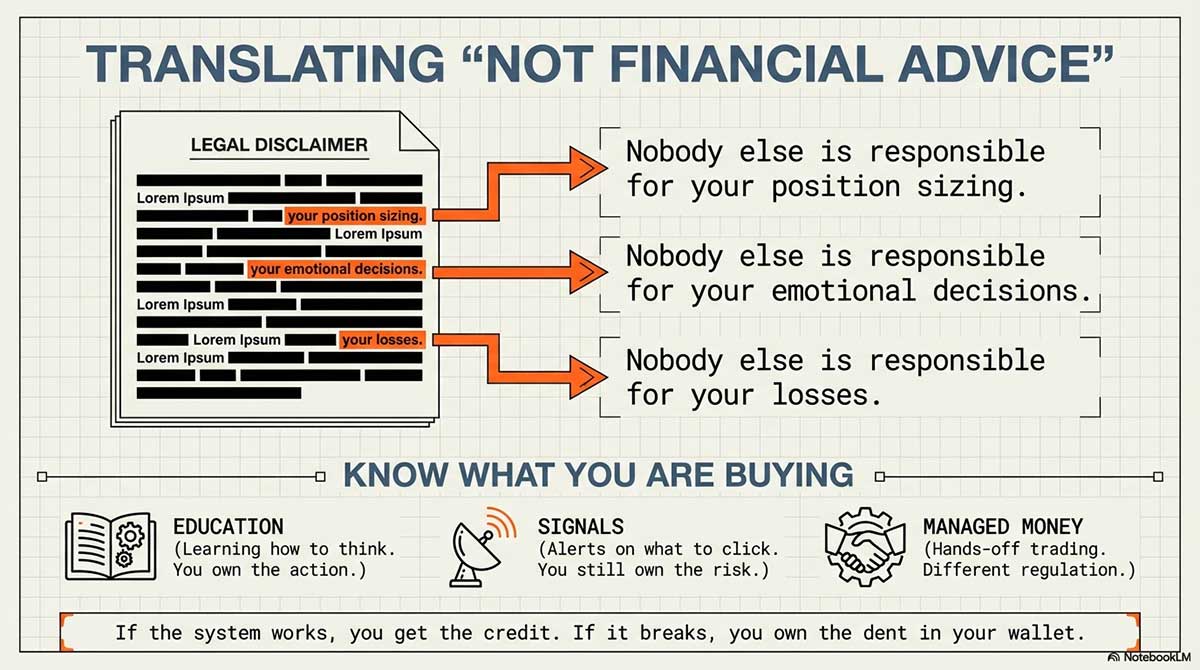
Most trainings include: “This is not financial advice.”
That line is not just legal filler. It is a flashlight.
It is telling you: you are the risk manager.
If the system works, you get the credit.
If the system breaks, you own the dent in your wallet.
So we translate disclaimers into practical rules.
“Not Financial Advice” Means You Need Your Own Rules
Here is the simplest interpretation:
- Nobody else is responsible for your position sizing
- Nobody else is responsible for your risk exposure
- Nobody else is responsible for your emotional decisions
- Nobody else is responsible for whether you should be trading at all
A good system helps you make fewer emotional decisions.
A great system makes it harder for you to override the safety rules.
Education vs Signals vs Managed Money
These are not the same thing:
- Education teaches you how to trade or invest
- Signals tell you what to trade (sometimes with entries and exits)
- Managed money means someone is directly managing your funds
If you are buying a course, you are buying education.
If you are also getting alerts, you are consuming signals.
If someone is taking your money and trading it for you, that is managed money and comes with a totally different set of risks and rules.
Many people get confused because the marketing sounds like managed money without the structure of it. So as you go through any training, keep asking:
Am I being taught how to think and act?
Or am I being told what to click?
Both can be useful. But they require different levels of responsibility on your end.
A Simple Risk Statement You Can Use (For Yourself)
Here is a short personal “risk statement” you can paste at the top of your trading notes:
- I will only trade with money I can afford to lose
- I will size positions so one loss does not matter
- I will not increase size to “make it back”
- If the system draws down beyond my limit, I pause and review
- My goal is consistency of process, not daily dopamine
That last line matters more than it looks like it does.
How AI Actually Fits Into Crypto Investing
AI is a great assistant. It is not a magic shield. It is more like:
A very fast intern with no fear.
Which can be either helpful or horrifying depending on your rules.
What AI Can Do Well
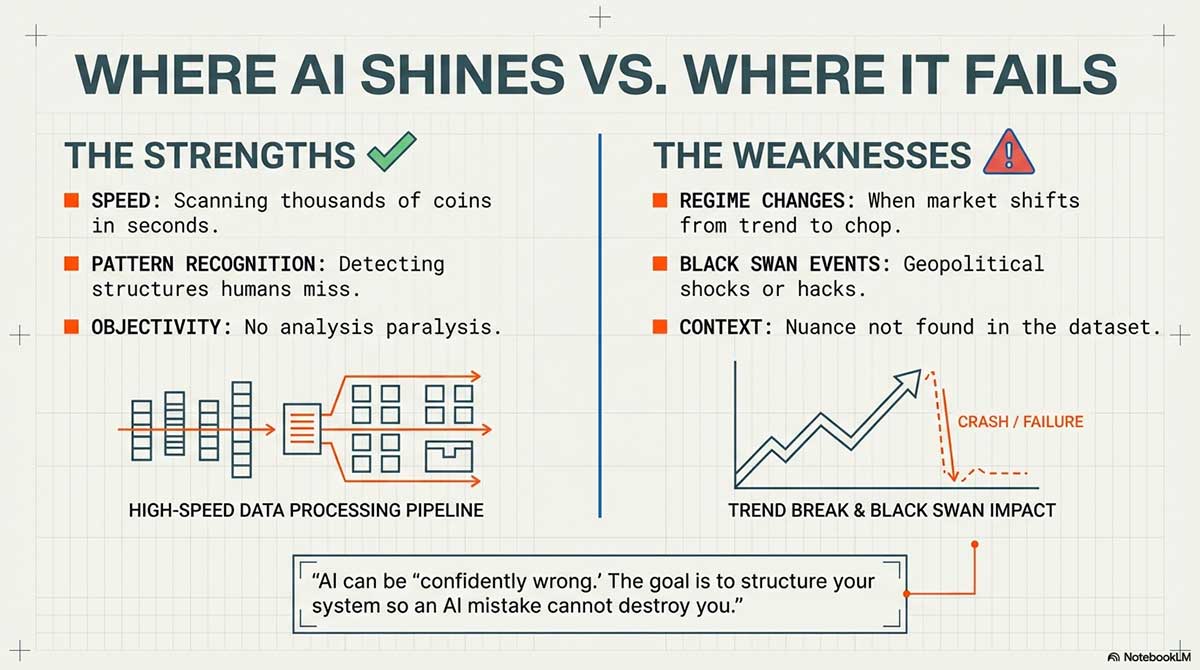
AI can be great at:
- Scanning many markets quickly
- Detecting repeating structures in data
- Ranking candidates by certain criteria
- Helping you avoid analysis paralysis
- Summarizing what happened and why
In other words, it helps with speed, breadth, and pattern recognition.
What AI Is Bad At
AI tends to struggle with:
- Sudden regime changes
- Black swan events
- Liquidity traps
- “Context” that is not in the dataset
AI can be wrong confidently. Humans can too. But AI can do it at scale.
So the goal is not to avoid AI mistakes. The goal is to structure your system so AI mistakes cannot destroy you.
Why “AI-Powered” Doesn’t Remove Human Decision-Making
Even if a tool gives you a “high confidence” signal, you still decide:
- How much to allocate
- Whether you are trading in the right market conditions
- Whether you are mentally clear enough to execute
- Whether to follow the system or override it
Your job becomes less “find the perfect trade” and more:
Run a risk-controlled process repeatedly.
If that sounds boring, good. Boring is often the signature of something that can work.
The Overall Training Roadmap (What You’ll Likely Learn Next)
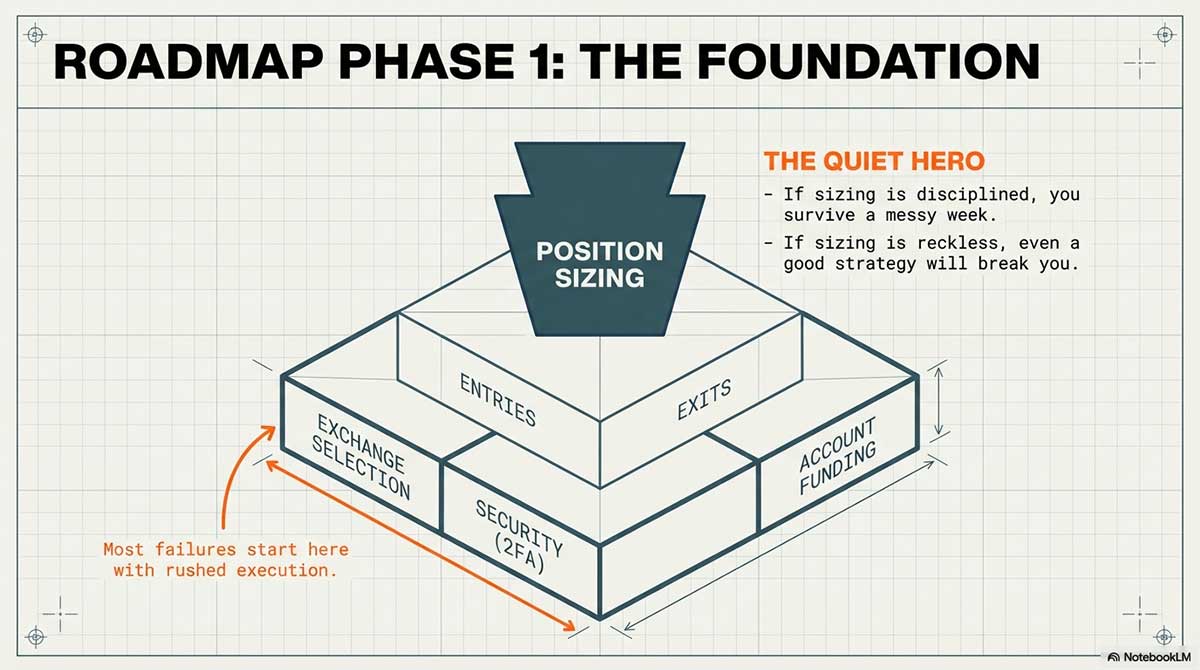
Most systems like this naturally break into four phases:
Setup
Rules
Routine
Review
If the training is well-built, it will take you through those phases in a way that reduces mistakes.
Setup: Accounts, Exchanges, Access, and Basics
Expect topics like:
- Choosing an exchange
- Funding your account safely
- Security basics (2FA, passwords, device safety)
- Basic order types (market, limit, stop)
This part is not glamorous.
It is also where most beginners get hurt.
Most “I lost money” stories start with something like:
“I rushed the setup because I didn’t want to miss the opportunity.”
You will always miss opportunities. The market produces new ones like a factory. Your goal is to still be alive for the next batch.
The Method: Entries, Exits, and Position Sizing
This is the heart of the system:
- What creates a valid setup
- Where to enter
- Where to exit
- How to size positions
Position sizing is the quiet hero.
If your sizing is disciplined, you can survive a messy week.
If your sizing is reckless, even a good strategy can break you.
The Routine: When to Check, What to Do, What to Ignore
“Autopilot” usually does not mean “never look.”
It usually means:
- Check once or twice per day
- Follow a checklist
- Place orders
- Walk away
The real win is reducing the number of moments where you can sabotage yourself.
The Review: Tracking Results and Improving
If the course is serious, it will encourage:
- Journaling trades
- Tracking metrics
- Identifying mistakes
- Adjusting exposure and rules cautiously
Most people skip review because it feels like homework.
But review is how you separate “I got lucky” from “this works.”
If you want a smoother way to build your own checklists, review templates, and daily routines, AIville is useful because it gives you ready-to-copy frameworks. You still think. You still decide. You just stop starting from zero every time.
Who This Is For (And Who Should Skip It)
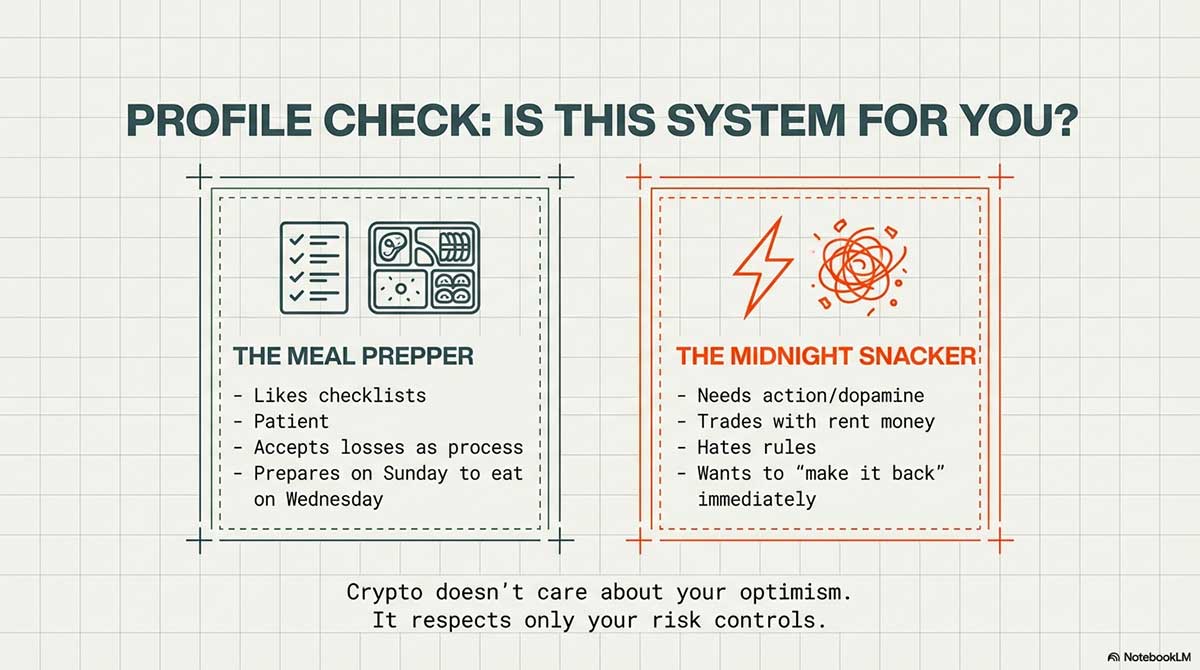
These systems are not for everyone. And that is a feature, not a flaw.
Best-Fit Profiles
This tends to fit people who:
- Like structure and checklists
- Can follow rules even when bored
- Want a repeatable routine more than excitement
- Accept losses as part of the process
- Wait for setups instead of forcing them
If you can meal prep on Sunday and actually eat the meals on Wednesday, you may do well here.
If your meal prep becomes midnight DoorDash by Tuesday, you will need stronger guardrails.
Red Flags: Who Should Be Careful (Or Avoid It)
Be careful if you:
- Hate rules
- Need action to feel alive
- Want to make it back quickly after a loss
- Plan to fund this with rent money
- Are hoping for a miracle instead of a process
Crypto does not care about optimism. It respects only risk control.
Minimum Starting Conditions: Expectations, Debt, and Sanity
A healthier baseline is:
- You have an emergency fund
- You are not trading to solve a cash crisis
- You can start small and treat it as skill-building
- You can commit to consistency for at least 90 days
If you are using this to rescue a stressful situation, emotional pressure will push you into mistakes.
A Reality Check Framework Before You Continue
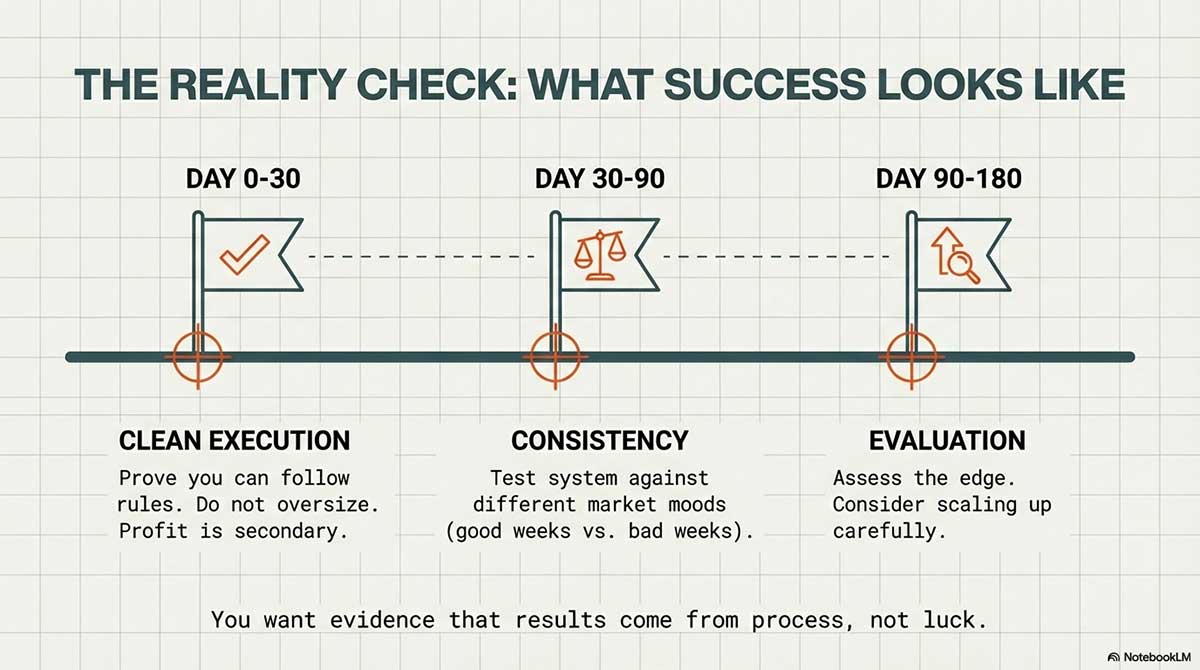
This is the most important part of the article.
Because if you do this right, you avoid the two classic tragedies:
- Quitting too early during normal losses
- Doubling down too hard during lucky wins
What Success Looks Like at 30, 90, and 180 Days
First 30 days:
Your goal is not big profits. Your goal is clean execution.
Aim for: followed rules, no oversizing, logged everything.
First 90 days:
Your goal is consistency across different market moods.
Aim for: fewer impulsive overrides, clearer setups, stable risk.
First 180 days:
Your goal is to evaluate edge and scale carefully.
Aim for: controlled drawdowns, steady execution, evidence it is process.
The 3 Numbers You Track From Day One
Track these three:
- Win rate
- Average win vs average loss
- Maximum drawdown
If you only track profits, you miss the story.
The real story is: how much risk did you take to get those profits?
The One Habit That Ruins Most “Autopilot” Systems
Overriding the system when emotions spike.
That looks like:
- Skipping stops
- Increasing size after a loss
- Jumping into invalid trades
- Taking profits early because you are scared
- Holding losers because you are hopeful
Hope is not a strategy. Fear is not a strategy. Anger is definitely not a strategy.
Your system should protect you from your worst five-minute decisions.
Closing Thoughts: The Real “Autopilot” Is You (And Your Community)
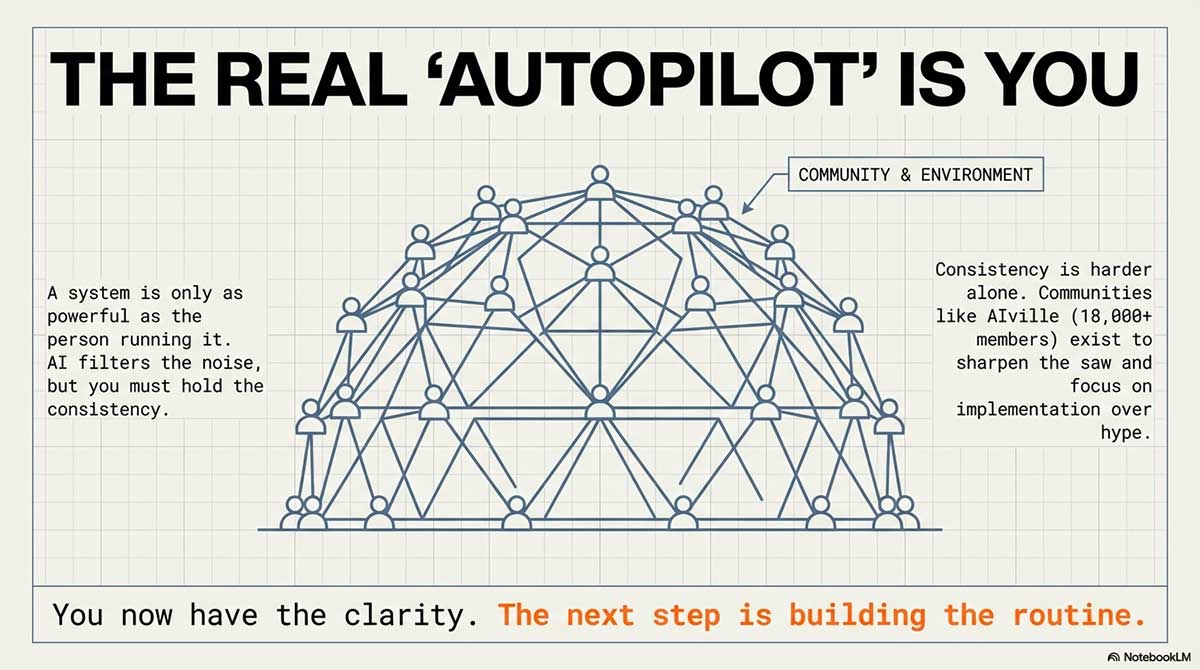
If you remember one thing from this entire article, let it be this:
A system is only as powerful as the person running it.
AI can help you filter noise, track signals, and build a repeatable workflow. But “autopilot” becomes real only when your rules are clear, your sizing is sane, and your routine is consistent.
And consistency is easier when you are not doing it alone.
If you want a place to sharpen the skills that actually make AI useful in the real world, AIville is worth checking out. Not as a magic button. More like a gym for practical AI workflows, templates, and routines you can copy, adapt, and actually use.
Because the only thing worse than being behind in crypto…
is being behind in AI and still trying to freestyle it under pressure.
Leave a Reply