
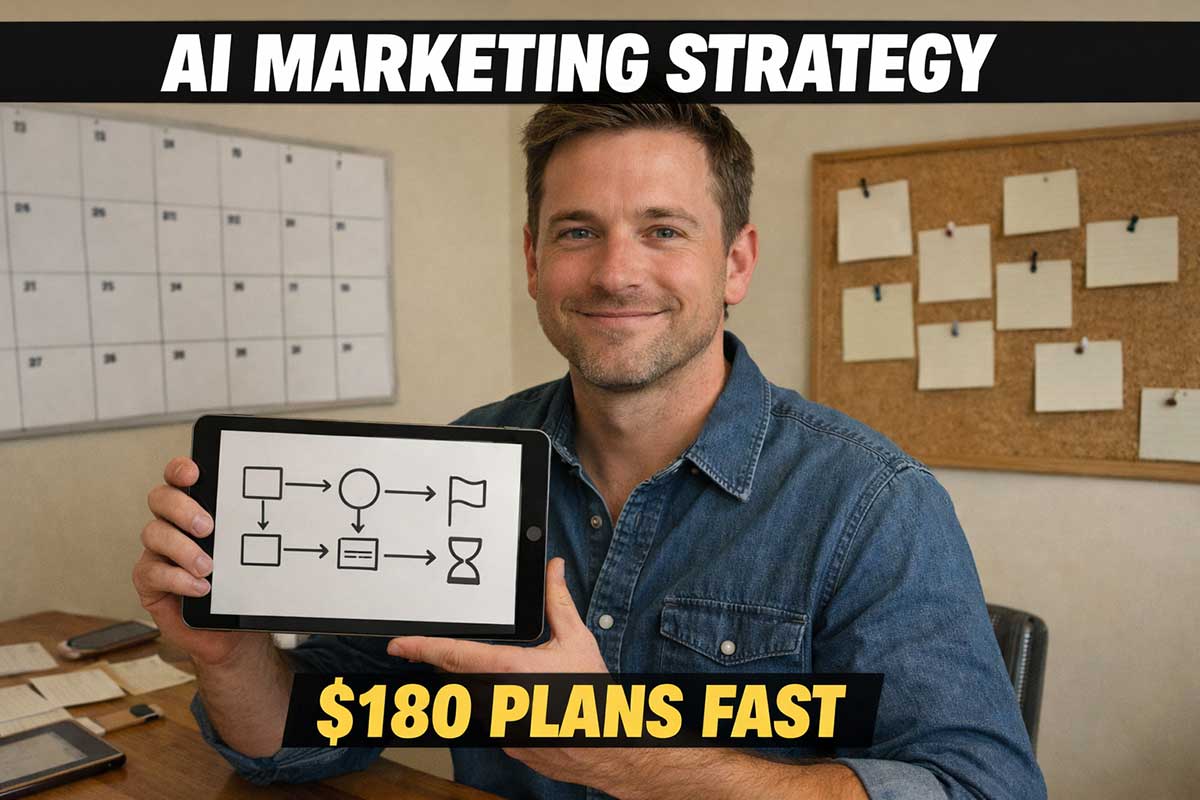
You know that feeling when a small business owner says, “I know I should be marketing… I just don’t know what to do first”?
That sentence is basically the national anthem of entrepreneurship.
And it’s also your opportunity.
Because in 2026, you don’t need to be a full-blown agency with a glass office, a ping-pong table, and a founder who says “synergy” without blinking. You can make real money by doing one thing: giving businesses direction.
Not ads. Not complicated funnels. Not “let’s redesign your brand voice and hold a two-hour workshop about fonts.”
Just direction.
A 12-month roadmap that tells them what to do next—broken down by month—so they stop spinning and start moving.
And AI makes this ridiculously doable.
If you want examples of what these “direction plans” look like when they’re packaged well, skim a few of the blueprint-style trainings from AIville. It’s the fastest way to stop guessing what goes in a roadmap and start shipping something clients will actually follow.
The New Side Hustle Nobody Warned Agencies About
Marketing strategy used to be a “big deal” service.
- You’d hire a consultant.
- They’d ask you 37 questions.
- Then they’d disappear for two weeks.
- Then they’d return with a PDF that looks like it was designed by a committee of exhausted accountants.
- And you’d pay them a lot of money and still wonder, “So… what do I do on Tuesday?”
Now? You can produce a strategy that feels agency-quality in hours (sometimes less), using AI as your brainy assistant.
But here’s the important part:
You are not selling AI.
You are selling clarity.
AI is the kitchen appliance. You’re the chef.
Nobody goes to a restaurant and says, “Wow, this soufflé is amazing—what brand is the oven?”
They care about the result.
The Business Model in One Sentence

Here it is. Write it on a sticky note. Tattoo it on your soul:
You sell a clear marketing plan that tells a business what to do for the next 12 months.
That’s it.
And the reason this works is painfully simple:
Business owners are drowning in options.
SEO. TikTok. Instagram. Email. Ads. YouTube. “AI reels.” “Threads.” “Shorts.” “Long form.” “Do webinars.” “Do podcasts.” “Do a brand refresh.” “Do PR.” “Do influencer outreach.”
At some point, their brain just plays the Windows shutdown sound and they go back to posting once every three weeks like:
“Happy Friday everyone!
”
And then they wonder why revenue is “a little slow lately.”
A strategy plan is oxygen to them.
The Fiverr Proof (Why This Is Not Just Theory)

One of the clearest examples of this model working is a simple Fiverr offer:
- A seller charges $180 for a 12-month marketing plan
- They have hundreds of reviews
- Even if you only count the base package, that’s tens of thousands of dollars
And here’s the wild part:
Most of these buyers could technically Google “how to market a bakery” or “how to promote my coaching business.”
But they don’t want information.
They want a decision.
They want someone to say:
- “Do these 3 channels.”
- “Ignore these 7 distractions.”
- “Here’s your monthly plan.”
- “Here’s what to measure.”
- “Here’s what to do first.”
That’s what they pay for.
If you’re thinking “cool… but I want a repeatable system so every client doesn’t feel like a brand-new science project,” that’s exactly where AIville helps. You can borrow structures, prompts, and deliverable formats that keep you consistent even when the client’s business is wildly different.
Your Simple 3-Offer Ladder (So You Don’t Just Sell One Thing)

If you want to make this work consistently, you don’t want only one product. You want a small ladder—simple enough to manage, but flexible enough to sell.
Here are the three easiest offers to start with:
1) The 12-Month Marketing Plan (Your flagship)
This is the “I need a roadmap” solution.
Deliverables usually include:
- Executive summary
- Target audience snapshot
- Positioning + differentiation
- Channel priorities (3–5 max)
- Content pillars
- Month-by-month plan
- KPIs + tracking
- Quick wins + sequencing
2) The Launch Campaign Playbook
This is for:
- New products
- New businesses
- New services
- A “rebrand relaunch”
- A course opening
- A book launch
Deliverables include:
- Pre-launch build
- Waitlist strategy
- Launch week schedule
- Email and content plan
- Offer bonuses + urgency
- Post-launch momentum plan
3) The Social Media Strategy Playbook
This is for people who are posting… but with the emotional consistency of a raccoon on espresso.
Deliverables include:
- Which platforms to focus on (and which to ignore)
- Content pillars
- Posting schedule
- Engagement habits
- Growth tactics
- Conversion path (how followers become customers)
Each one can be a standalone gig.
Or you can bundle them.
The Prompt Stack That Does the Heavy Lifting (Without Turning You Into a Robot)

Now let’s talk about the part everyone wants: how AI fits in.
AI works best when you treat it like a world-class specialist and give it context like you’re briefing a pro.
If your prompt is:
“make a marketing plan for my business”
AI will respond like it’s half-awake at a dinner party.
But if your prompt assigns a role and a structured output, AI becomes terrifyingly useful.
Your basic approach:
- Tell AI what role it is playing (CMO, strategist, launch expert)
- Tell it the steps it must follow
- Tell it the format you want
- Feed it the business info
Then you refine.
Because again: you’re the chef.
AI is the sous-chef who works fast and doesn’t complain.
What to Ask the Client (So You Don’t Get Garbage Inputs)

Before you run any prompt, you need decent inputs.
Here are the minimum questions that make your output dramatically better:
- What do you sell (in one sentence)?
- Who is your ideal customer?
- What is your offer price range?
- What’s your monthly marketing budget (even if tiny)?
- What have you tried already?
- What’s working even a little?
- What’s your biggest goal in the next 90 days?
- What’s your biggest constraint (time, money, team, confidence)?
That’s enough.
You do not need a 90-question intake form.
If they can answer these, AI can generate a high-quality plan.
How to Make Your Deliverables Look Like You Charge More Than You Do

Here’s a truth about buyers:
They don’t judge your strategy by its genius.
They judge it by how it feels.
So presentation matters.
Use this format (it wins because it respects attention spans):
- 1 page executive overview
- 12-month monthly plan
- Checklist
- Metrics
That’s it.
You can include deeper sections, but lead with clarity.
Because business owners don’t want to “study marketing.”
They want to do marketing and get paid.
Also: always include a checklist.
A checklist makes clients feel like they hired a professional.
A checklist is basically a dopamine dispenser.
If you want a couple ready-to-use checklist formats (monthly plan checklist, KPI checklist, content pillar checklist) without building them from scratch, AIville usually has templates you can copy and adapt in minutes. Future You will thank Present You. Loudly.
How to Create a Fiverr Gig That Ranks and Converts

Fiverr success is not magic. It’s:
- Keywords
- Positioning
- Clear outcomes
- Proof (even sample proof)
- Good packaging
The positioning that sells best
Don’t sell “marketing strategy.”
Sell direction.
You are the person who ends the chaos.
Your promise is:
“I will tell you exactly what to do next.”
That’s what people are buying.
Your gig titles should not be a grammatical crime
Some sellers write titles like:
“I will create marketing strategy with plan and execution steps”
It sells, yes.
But you can do better.
Examples:
- “I will create a 12-month marketing plan to grow your business”
- “I will build your marketing roadmap with monthly action steps”
- “I will design a clear strategy to attract customers consistently”
Packages (keep them simple)
- Starter: quick strategy snapshot (light plan, fewer channels)
- Standard: full 12-month roadmap (your best seller)
- Premium: roadmap + launch plan + optional call
And yes—people buy premium if it’s framed as “implementation support.”
They’re not paying for time.
They’re paying for confidence.
Where Your First Clients Actually Come From (Besides “Hope”)

Here’s the bad news:
If you post a Fiverr gig and wait, you might get clients.
Eventually.
When the moon is in alignment and the algorithm feels emotionally available.
Here’s the good news:
You can bring clients to your Fiverr gig.
The “micro-value first” method
Post a simple marketing tip that is actually useful.
Examples:
- “If your website headline could be used by your competitor, it’s too vague.”
- “Your social content needs three buckets: trust, proof, and invites.”
- “Pick 3 channels. Commit for 90 days. Stop platform shopping.”
Then say:
“If you want a full 12-month plan, my Fiverr is in my bio.”
That’s it.
No begging.
No weird pitching.
Just gravity.
How to Deliver Fast Without Delivering Garbage
AI makes speed possible. But speed without standards becomes chaos again—just in a new outfit.
Here’s a simple quality control routine:
The 10-minute sanity check
Before you deliver:
- Does the plan match their budget reality?
- Are the channels appropriate for their audience?
- Are there clear KPIs?
- Does every month have a focus?
- Does it tell them what to do first?
If you can answer yes, you’re good.
If not, you adjust.
Because that’s your real value: judgment.
Scaling This Into Real Income (Without Becoming a Burned-Out Spreadsheet)

Once you deliver a few plans, you’ll start noticing patterns.
That’s where scaling happens.
Turn your process into templates (without being generic)
You can reuse:
- Strategy structure
- Section headers
- KPI lists
- Calendar format
But customize:
- Audience triggers
- Differentiators
- Channel mix
- Monthly campaigns
- Offer angles
Add recurring offers
Want predictable income?
Offer:
- Quarterly strategy refresh
- Monthly check-in call
- Content calendar updates
- “Campaign planning” as a monthly service
This turns one-time Fiverr orders into ongoing relationships.
Ethics and Reality Check (So You Don’t Feel Gross)
A few rules that keep you clean:
Don’t promise “guaranteed results.”
Promise:
- clarity
- prioritization
- a plan they can execute
- measurement
Be transparent about your role
You’re not claiming you built Meta’s ad algorithm.
You’re giving direction and strategy—with AI as your assistant.
Your value is not typing
Your value is:
- asking the right questions
- choosing the right priorities
- packaging it clearly
- turning chaos into action
That’s worth paying for.
Final Thoughts — Why AIville Is the Community You’ll Want Around You

If you do this solo, you can absolutely succeed.
But here’s what happens to most people:
They get excited.
They try a few prompts.
They get a little stuck.
They get distracted by another tool.
They stop.
Not because they aren’t smart.
Because they’re alone.
That’s the real advantage of a community like AIville.
AIville isn’t just “prompts.”
It’s momentum.
Based on what Chris described, the benefits are straightforward:
- A massive library of tools, prompts, and blueprints
- Live streams that break down what’s trending and how to profit from it
- A large, active community (not a dead group full of bots)
- A culture of people learning AI together—so you don’t stall out when you hit friction
In other words: it’s not just a toolbox.
It’s an environment.
And if you’re serious about making money with AI—especially building services like marketing strategies—being around people doing it right now is the difference between “I should do this someday” and “I just got my third client.”
So yes, you can start today with a prompt and a Fiverr gig.
But if you want to keep leveling up through 2026—with better prompts, better strategy, better execution, and a community that keeps you moving—AIville is the kind of place you’d at least want to take a serious look at.
Because the only thing worse than being behind in marketing…
is being behind in AI while everyone else is sprinting.
If you want a place to borrow proven templates and keep your momentum when you hit a wall, take a look at AIville and see if it matches how you like to learn.
Leave a Reply