
How to Make Money With AI Critiquing Websites (Without Being a “Web Design Person”)
If you’ve ever looked at a website and thought, “I… don’t know what this company does,” then congratulations—you already have the first qualification for getting paid to critique websites.
Because that moment of confusion? That’s not just a feeling. It’s a revenue leak.
And the crazy part is: a lot of business owners know something is off. They can feel it in their numbers, in their bounce rate, in the silence after they spend money on traffic. But they can’t see their own site the way a stranger does. They’re too close to it, like someone who can’t smell their own cologne anymore.
This is where AI becomes your unfair advantage.
If you want to see how people are turning that advantage into a repeatable service, take a quick look at AIville. It’s basically a shortcut library of practical AI workflows and templates, so you’re not reinventing the same critique format every time.
You can use AI to generate professional-grade website critiques—structured, specific, prioritized—without spending five years learning conversion rate optimization (CRO), UX design, and copywriting. You’re not “building websites.” You’re doing the thing that business owners will happily pay for because it tells them what to fix first.
And yes, people really do pay premium prices for this. On platforms like Fiverr, sellers charge hundreds per critique. Not to redesign the site. Just to point out what’s broken and how to repair it.
If you want a shortcut to doing this cleanly—prompts, templates, and blueprint-style workflows that keep your audits consistent—AIville is built around exactly that kind of “repeatable deliverables” mindset. You can still do this without it, but systems beat vibes every time.
Why Website Critiques Sell (Even When the Website “Looks Fine”)
Here’s the awkward truth about websites: a site can look “good” and still convert like a wet paper towel.
Businesses don’t need a prettier website. They need a website that makes people do something.
A critique helps because it answers questions the owner can’t answer alone:
- What do visitors notice in the first five seconds?
- Do they understand the offer immediately?
- Is the next step obvious?
- Is there trust, or is it “mysterious stranger in a trench coat” vibes?
- What’s distracting, confusing, slow, or suspicious?
Most owners don’t know what “good” looks like in conversion terms. They compare themselves to competitors, not to best practices. And competitors are often just as confused—like a neighborhood where everyone’s lawn is dying, so everyone agrees brown grass is normal.
A website critique feels like relief because it turns vague anxiety into a prioritized plan. And “prioritized plan” is one of the most valuable phrases in business. It means: “I know what to do next.”
That’s what you sell.
Not opinions. Not aesthetic judgments. A plan.
If you want a ready-to-use structure for critiques—so every project doesn’t start from scratch—AIville is the kind of place where you can grab a proven framework and just run it.
The $500 Website Critique Isn’t Magic—It’s Packaging

When you hear “$500 for a website critique,” the brain does a little cartoon double-take. Like it just got hit by a comedic frying pan.
But that price isn’t paid for the act of “looking at a website.” It’s paid for:
- Confidence (the critique sounds like it came from someone who knows what matters)
- Clarity (the feedback is specific, not generic)
- Prioritization (what to fix first, second, third)
- Business impact language (revenue leaks, friction, trust breakdowns)
- A premium-feeling delivery (a report that looks like it belongs in a board meeting)
Most cheap critiques fail because they feel like random notes:
- “Maybe make the logo bigger?”
- “Try changing the font?”
- “I don’t like the color.”
That’s not a critique. That’s a polite argument with a paintbrush.
A premium critique reads like:
- “Your above-the-fold message doesn’t clarify who this is for or what outcome they get.”
- “Your CTA is visually buried, and the page forces visitors to work too hard to find pricing.”
- “You’re missing trust signals at the exact moment a buyer is deciding whether you’re legitimate.”
The difference is structure.
AI can help you produce that structure instantly, as long as you tell it what role to play and what steps to follow.
What AI Does Best Here: Turn You Into a “Conversion Detective”

You’re not becoming a designer. You’re becoming a detective.
Your job is to walk through a site like a first-time visitor and identify:
- Confusion
- Friction
- Missing trust
- Weak messaging
- Bad flow
- Slow or cluttered experiences
- Unclear next steps
- Unaddressed objections
And then you translate that into:
- Quick wins (high impact, low effort)
- Medium improvements (some effort, meaningful return)
- Big projects (higher effort, bigger lift)
That’s what makes the critique feel like value—because it respects the owner’s limited time and attention. Nobody wants a 47-item to-do list that makes them want to move to a cabin and become a bird.
They want: “Do these three things first.”
The Simple Business Model: Critique → Report → Upsells

Here’s the basic ladder you can build:
1) Paid Website Critique
You deliver a structured report: conversion issues + prioritized fix list.
2) Add-On: Video Walkthrough
A 5–10 minute Loom-style explanation (if you choose).
3) Add-On: Competitor Comparison
You critique 1–2 competitors and show what they do better.
4) Add-On: Landing Page Rewrite
You rewrite above-the-fold copy, CTAs, and key sections.
5) Add-On: Implementation Plan
A checklist or Trello-style plan.
6) Optional: “Rebuild” Upsell
If you want, you can use site builders or dev tools to create a revised version. This is not required to make the model work—but it’s a natural expansion later.
You can start at step 1 tonight.
If you like learning by copying what already works, AIville is a nice place to borrow battle-tested prompt setups and report structures. It saves you from doing that classic freelancer move where you spend three hours “preparing,” then reward yourself with a snack like you just shipped a NASA launch.
The “You Don’t Need Experience” Problem (And Why It’s Not Actually a Problem)

Most people don’t start because they think:
- “I’m not qualified.”
- “I don’t know CRO.”
- “I’ve never optimized a landing page.”
- “People will see through me.”
Two points:
First: buyers don’t want theory—they want clarity
A business owner isn’t hiring you to pass a university exam. They’re hiring you to tell them why the site isn’t working and what to do next.
Second: your deliverable is structured thinking
If your report follows a proven framework, it feels professional. AI helps fill in best practices and language. Your job is to guide it, sanity-check it, and present it.
You’re not pretending to be a wizard. You’re using a system.
And systems are what businesses pay for.
The Exact Structure of a High-Value Website Critique

Here’s the format that makes your report feel “premium,” not random.
H3: 1) First Impression (5 seconds)
- What’s the first thing you notice?
- Is the offer obvious?
- Who is this for?
- What should I do next?
- Does the site feel trustworthy?
H3: 2) Above-the-Fold Audit
- Headline clarity and outcome
- Subheadline support
- Hero image relevance
- CTA visibility and specificity
- Navigation simplicity
- Trust signals present/missing
H3: 3) User Flow & Friction
- Where does a visitor go next?
- Are there too many choices?
- Is pricing easy to find?
- Are forms asking for too much too early?
- Does anything feel broken, slow, or confusing?
H3: 4) Copy & Message Review
- Benefits vs features
- Scannability
- Specificity
- Objection handling
- Consistency of tone
H3: 5) Trust & Credibility
- Testimonials
- Case studies
- Guarantees
- Contact info visibility
- About page strength
- Security / reassurance at decision points
H3: 6) Mobile Experience
- Tap targets
- Speed
- Readability
- Sticky buttons / mobile friction
H3: 7) Prioritized Recommendations
- Quick wins
- Medium improvements
- Big projects
H3: 8) Executive Summary
- 5–10 bullet “biggest issues”
- The “fix first” list
This is the skeleton. AI helps you put muscle on it.
If you’re doing multiple critiques, a template like this is everything. It keeps you consistent, fast, and confident. It also prevents the classic freelance disease: “Every project becomes a brand new novel.”
AIville is useful precisely because it encourages this kind of repeatable blueprint thinking—prompts, frameworks, and deliverable structures you can reuse without starting over.
How to Run the Critique in Real Life (Without Overthinking)

Step-by-step:
1) Pick one website
Start with:
- A local business site
- A friend’s site
- A random Shopify store
- A popular brand site (for practice)
2) Experience it like a buyer
Do the “dumb visitor” test:
- Open the site
- Don’t scroll for 5 seconds
- Ask: “What is this? For who? What do I do?”
Write what you feel. Confusion is data.
3) Click the primary path
If it’s ecommerce:
- Product page → add to cart → checkout
If it’s service:
- Services page → pricing → contact → booking
4) Note friction
Where do you hesitate?
Where do you wonder?
Where do you lose interest?
5) Feed it into your AI critique prompt
AI will generate a structured report.
6) Sanity-check the output
This is important: AI can be confident and wrong. Your job is to check:
- Does it match what you saw?
- Is it making assumptions?
- Is it suggesting irrelevant things?
7) Improve the report’s value
Add:
- A prioritized “fix first” list
- Optional examples of improved wording
- Clear next steps
That’s a premium deliverable.
Selling This on Fiverr (Or Anywhere) Without Feeling Cringey

The fastest place to start is Fiverr because:
- Buyers already go there for “website critique,” “CRO audit,” “landing page review,” etc.
- You don’t need an audience
- You don’t need ads
- You can start with one gig and improve it over time
What your gig should NOT say
“I will critique your website.”
That’s a commodity. That’s like saying, “I will look at your sandwich.”
What your gig should say instead
“I will identify why visitors aren’t converting and give you a prioritized action plan.”
That’s outcome-based. That’s valuable.
Your gig packages should be outcome-first
Instead of “Basic / Standard / Premium,” think:
- Quick Diagnose
- Full Conversion Critique
- Complete Website Teardown + Roadmap
(You can still label them Basic/Standard/Premium, but the framing matters.)
Your samples matter a lot
Even if you’re new, you can create:
- 2–3 sample report pages (blurred or template style)
- A sample “executive summary”
- A sample “prioritized roadmap”
People buy confidence. Samples create it.
If you want to move faster here, AIville-style blueprint prompts make it easier to generate consistent gig descriptions, packages, FAQs, and deliverable templates—so your Fiverr presence doesn’t look like a first draft.
How to Get Clients Faster Than “Waiting For Fiverr To Bless You”

Yes, Fiverr can bring inbound leads. But the fastest growth comes when you bring your own traffic too.
Here are realistic methods that don’t require you to become an influencer overnight:
1) Post “micro-critiques” in business groups
In Shopify groups, local business groups, founder communities:
- Offer a 3-bullet critique of someone’s homepage
- End with: “If you want a full prioritized roadmap, I offer paid critiques.”
2) LinkedIn comments
Whenever someone announces a launch:
- Congratulate them
- Offer one quick improvement suggestion
- DM if they want a full critique
3) Short-form “roast” videos (friendly)
You can do:
- “One thing this homepage does well”
- “One thing that’s costing them sales”
Make it playful, not mean.
4) Partner with web designers
Designers often hate copy and strategy. You can be the “conversion strategy partner.”
5) Build a mini-portfolio
Post 3 critiques on your own site or Medium:
- “Homepage teardown: what’s working, what’s missing, what to fix first”
This becomes proof.
And the moment you get your first happy client, ask for:
- A review
- A referral
- A one-sentence testimonial
That’s how the flywheel starts.
What to Deliver (So Clients Feel Like They Got More Than They Paid For)

A simple way to make the critique feel premium:
Include these sections every time
- Executive summary (top 5 issues)
- Conversion killers (what’s bleeding money)
- Fix-first roadmap (quick wins → bigger projects)
- Copy rewrites for headline + CTA
- Trust checklist (what’s missing)
- Mobile red flags
Add “implementation-ready” details
Instead of: “Add trust signals,” say:
- “Add 3 testimonials near the CTA”
- “Add a guarantee statement near pricing”
- “Add an ‘About’ snippet with credentials near the form”
Specificity is the difference between “advice” and “consulting.”
Your 7-Day Starter Plan (So You Don’t Just Read This and Feel Motivated)

If you’re going to use humor in your marketing:
- Make the website the joke, not the owner
- Make the problems universal (“we’ve all done this”)
- Make your tone: helpful older sibling, not internet bully
You’re not trying to go viral for cruelty. You’re trying to build trust.
Humor works best when it communicates:
- “I see the problem clearly.”
- “I’m calm.”
- “I can fix this with you.”
That’s the sweet spot.
AIville’s strength (for this specific business model) is helping you stay in that sweet spot—structured, confident, repeatable—so you can deliver fast without your brain melting.
Final Thoughts: Why AIville Makes This Easier (7 Reasons)

You can absolutely do this business model without joining anything. But if your goal is to make this a repeatable income lane (not a one-time experiment), you want a system that reduces friction.
Here are 7 practical reasons AIville can help if you’re serious about making money critiquing websites with AI:
Blueprint-style structure
You’re not guessing what to include in a critique. You start with a proven framework and fill it in.Faster ramp-up
You spend less time learning “what to do” and more time doing it—publishing gigs, sending offers, delivering reports.Consistency across clients
Your critiques don’t vary wildly. The structure stays strong, and that builds your confidence (and your reviews).Better deliverables
The difference between “I looked at your site” and “Here is your prioritized conversion roadmap” is templates and formatting.Easier upsell expansion
Once you have critique prompts, you naturally expand into landing page rewrites, competitor comparisons, and implementation roadmaps.Prompt library compounding
You build a personal library of prompts and variations that stack over time. Each new gig becomes easier than the last.A cleaner path to becoming “the outcome person”
Clients don’t hire tools. They hire outcomes: “Find what’s broken and tell me what to do first.” AIville helps you operate like that person.
If you’ve read this far, you’re not casually curious. You’re looking for a real lane. And “paid website critique with AI” is one of the cleanest lanes because you can start small, deliver fast, and charge more as your reports improve.
If you want the fastest path to a structured, repeatable workflow—prompts, blueprints, and deliverables you can reuse—joining AIville is the most obvious next step.
Quick Recap (Your “Do This Tonight” Checklist)
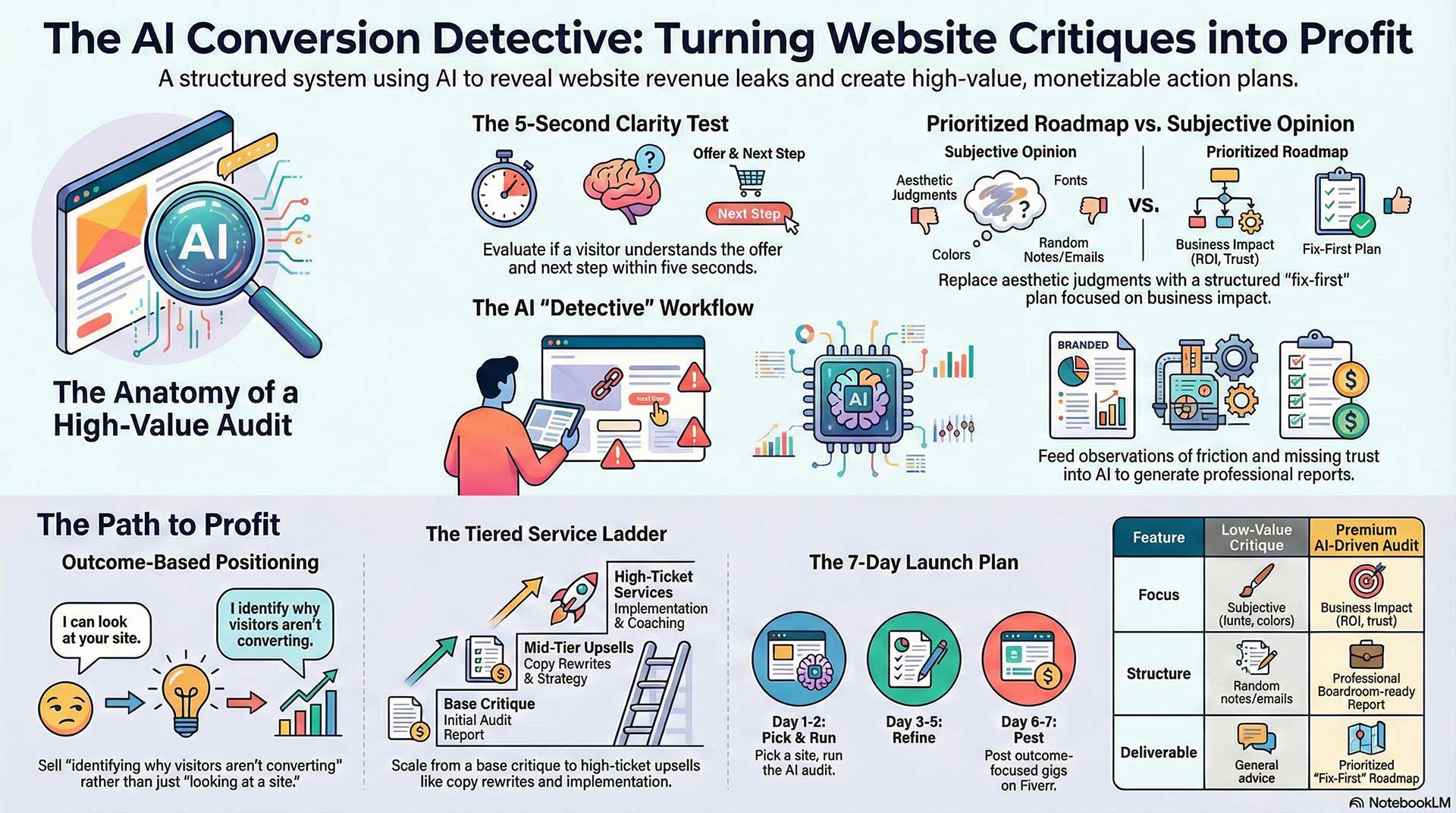
- Pick a website (any site)
- Run the 5-second clarity test
- Walk the conversion path
- Note friction + missing trust
- Use AI to generate a structured critique
- Add a prioritized fix-first roadmap
- Create a Fiverr gig with outcome-based positioning
- Post 1–2 micro-critiques publicly to attract interest
And then repeat.
Because the secret is not genius.
The secret is repetition—with a good framework.
If you want to move faster (and not feel like you’re doing this alone in a dark room with 19 browser tabs and one cold cup of coffee), check out AIville. It’s a big community of people actually building with AI, plus the kind of templates and prompt frameworks that make your critiques cleaner and your delivery more consistent.
Leave a Reply